
YEP–Project MARITES 2026 Equips Cordillera Youth to Turn Ideas Into Businesses
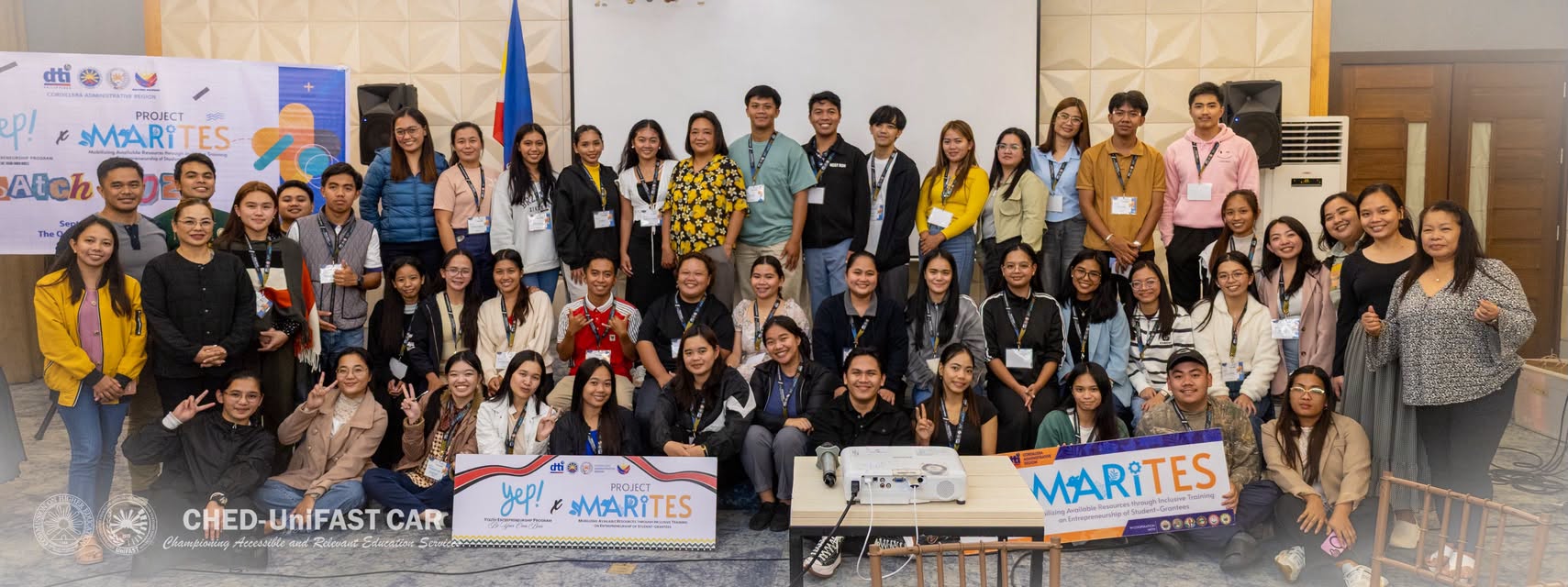
Thirty-seven young entrepreneurs completed the four-day YEP–Project MARITES Batch 2026 training in Baguio City, culminating in a regional pitch competition where five finalists presented refined business ideas. From an IoT-based water monitoring system to surplus-vegetable noodles and upcycled crafts, the projects showed how mentorship can help young innovators move from promising concepts toward market-oriented ventures.
 Featured
Amianan Ventures
From Training to the Pitch
For the 37 young people who completed YEP–Project MARITES Batch 2026, the final day was not simply about receiving recognition. It was a chance to put several days of learning into practice.
The four-day entrepreneurship training, held from September 1 to 4, 2026 at The Orchard Hotel in Baguio City, brought together young entrepreneurs for workshops covering sustainable development, business model refinement, digital entrepreneurship, marketing and sales, financial simulation, pitch deck development, and team coaching.
Implemented by CHED-CAR with DTI-CAR, in cooperation with state universities and colleges in the Cordillera, the program also involved UP Baguio SILBI and the City of Baguio SIGLAT Youth Innovation Hub.
By the time the participants reached the culminating activity, they were no longer presenting their ideas exactly as they had started.
Five Ideas Take the Regional Stage
The afternoon of September 4 featured the 2026 Regional Youth Business Pitch Competition, where the top mentees presented their business concepts before a panel of entrepreneurs and industry professionals.
The overall winner was Aprilia U. Del Rosario, a TES beneficiary from the University of the Cordilleras, with AmpFlow, an IoT sensor kit designed for real-time level monitoring and automated pump control.
Her pitch was recognized for its technical feasibility, market relevance, and value proposition for water-dependent communities and industries.
Second place went to Kayla Jane W. Langbayan of Mountain Province State University for Ani-Pancit, a nutritious noodle product made from surplus vegetables.
Ceasar James D. Osben, an alumnus of Benguet State University, placed third with Withers, a line of dehydrated instant vegetables designed around convenience, longer shelf life, and healthier food options.
Fourth placer Crisanta B. Cabbigat of Mountain Province State University presented HabiLab, a hands-on craft laboratory and learning center for youth and hobbyists.
Rounding out the top five was Aizel B. Himmoldang of Ifugao State University with Eycelle Handmade, a crochet and upcycling venture producing affordable and personalized handcrafted items.
The diversity of the ideas is notable. They address water management, food innovation, agricultural value-adding, creative education, and sustainable crafts—showing that entrepreneurship can emerge from very different community needs and interests.
What Happens Between an Idea and a Business
A pitch competition can make entrepreneurship look straightforward: identify a problem, develop an idea, and present it.
In practice, there is considerably more work in between.
That is why the training component of YEP–Project MARITES matters.
Business model refinement, financial simulation, marketing, sales strategy, and pitch development force participants to look at their ideas from different perspectives.
Who is the customer?
What problem is actually being solved?
How will the product reach the market?
Can the business make money?
What needs to change before someone is willing to buy?
These questions can turn an interesting concept into a more structured business proposition.
Mentorship Makes the Difference
The finalists also presented their ideas before judges with experience in entrepreneurship, food products, manufacturing, and business management.
The panel included Sherryl Flores, June Jay Sanlao, Rouhwella P. Pinder, Janice O. Cadsi, and Mark Alfred A. Parajillo.
Their involvement provided another layer of market-oriented feedback.
For young entrepreneurs, this kind of interaction can be particularly valuable. Experienced business people can challenge assumptions that may not be obvious to someone developing an idea for the first time.
The goal is not simply to make a pitch sound better.
It is to make the underlying business idea stronger.
From Competition to the Next Stage
Winning a pitch competition does not guarantee that a venture will succeed.
For the five finalists, the more interesting question is what happens next.
AmpFlow will need to validate its technology and understand its potential customers. Ani-Pancit and Withers will need to test product quality, pricing, demand, and distribution. HabiLab and Eycelle Handmade will need to determine how their creative offerings can consistently reach their intended markets.
Each idea faces different challenges.
That is precisely why entrepreneurship programs are most useful when they create pathways beyond the competition—toward prototyping, customer validation, mentoring, market access, and continued business development.
What This Means for the Cordillera’s Innovation Ecosystem
Programs such as YEP–Project MARITES contribute to the early pipeline of entrepreneurs in the region.
The participants come from different institutions and backgrounds, but the program gives them a shared opportunity to learn how ideas can be developed into potential businesses.
For the Cordillera, that matters.
A stronger innovation ecosystem needs people who can identify problems, develop solutions, test assumptions, and eventually build organizations around those solutions.
Universities and government programs can provide the initial support. Mentors and industry practitioners can provide experience. Markets and customers provide the ultimate test.
The stronger the connections among these parts, the easier it becomes for promising youth-led ideas to continue developing after a program ends.
The Bigger Story Behind the Five Winners
The five finalists represent only a small portion of the 37 young people who completed the training.
Their projects, however, illustrate what can happen when young entrepreneurs are given structured mentorship and a place to test their ideas.
Some may eventually become businesses. Others may evolve into different projects or take their founders in another direction.
Either way, the experience provides something valuable: an understanding that entrepreneurship is not only about having an idea.
It is about testing that idea, listening to the market, improving the business model, and continuing to build.
For the Cordillera’s young innovators, the September 4 pitch may have been the culmination of the program—but for some of them, it could also be the first public step toward building a real venture.
Original Source
Market Context
Youth entrepreneurship programs play an important role in developing an early pipeline of innovators and business founders. In the Cordillera, programs that combine entrepreneurship training, mentorship, business-model development, and pitching can help young people move beyond simply generating ideas toward understanding what it takes to build a viable venture.
The next opportunity is to strengthen the pathway after the competition: idea → validation → prototype/product development → market testing → venture growth. This is where continued mentorship, industry connections, and access to customers can determine whether promising youth ideas develop into sustainable enterprises.
Are you a founder, innovator, or community builder in Northern Luzon?
We're always looking for compelling stories from the region's ecosystem. Whether you're launching a startup, running a program, or doing something interesting — we'd love to feature you.