
Creative Futures Brings Innovation Through Local Materials and Traditional Skills in Mountain Province
A four-day Creative Futures roadshow across Bauko, Besao, Sagada, and Tadian is showing how innovation can begin with resources already found in communities. By combining traditional craftsmanship, creative design, entrepreneurship, and discarded materials, the initiative is helping communities explore new products and livelihood possibilities rooted in local identity.
 Featured
Amianan Ventures
Innovation is often associated with advanced technology, sophisticated equipment, or expensive research and development.
In Mountain Province, however, innovation is taking a more familiar form: pine cones, discarded fabric, scrap paper, bamboo, and recycled packaging materials being turned into new products.
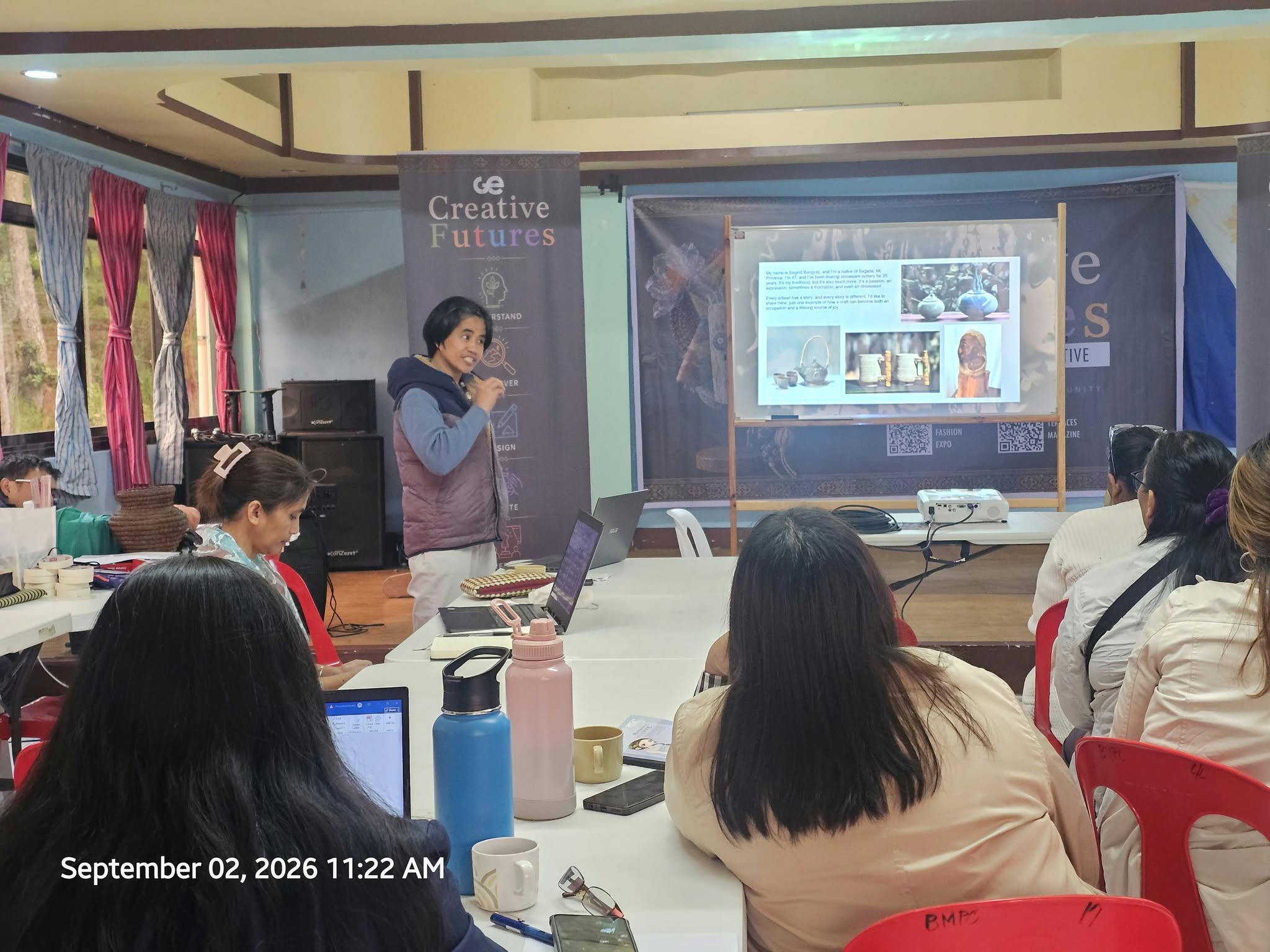
From September 1 to 4, 2026, the Creative Futures: Mountain Province Initiative brought seminars and hands-on workshops to Bauko, Besao, Sagada, and Tadian, encouraging communities to look differently at the resources around them—and at the possibilities within their existing skills.
Led by creative entrepreneur and artisan Harvic G. Dominguez and his team, the roadshow brought together creative practitioners, artisans, communities, government agencies, local governments, and tourism offices. The initiative was conducted with DTI–Mountain Province, TESDA–CSITE, the Provincial Government of Mountain Province, and local partners.
Innovation Starts With What Communities Already Have
The Bauko session opened the roadshow with pine cones and pine needles as raw materials.
Rather than treating these materials simply as natural resources, participants explored how they could become products with practical and market value. The workshop resulted in prototypes including baskets, pen holders, vases, lamps, and Christmas décor.
The exercise illustrates an important principle in innovation: a new product does not always require a new material.
Sometimes, innovation comes from finding a different use for something that is already available.
The process also went beyond making products. Participants received feedback on design, functionality, and market readiness—three considerations that become increasingly important when a creative output moves from a workshop into a potential business.
That shift—from making something interesting to creating something people may actually want to buy—is where creativity begins to intersect with entrepreneurship.
Traditional Skills Can Become Platforms for New Products
The Besao leg demonstrated another dimension of innovation.
Local rug weavers were challenged to use cutouts from old clothes and discarded fabric materials while applying their existing weaving skills.
The result was not a replacement of traditional craftsmanship, but an expansion of what those skills could produce.
This is particularly relevant for communities with established craft traditions. Innovation does not necessarily mean abandoning traditional techniques in favor of something entirely new. It can mean reinterpreting those techniques for new products, customers, and markets.
The resource speakers also provided recommendations on the prototypes, particularly in terms of improving their marketability.
That feedback loop is important. A prototype is only an early step. Design refinement, customer preferences, pricing, production capability, and market positioning eventually determine whether an idea can become a viable product.
From Scrap Paper to Creative Enterprise
In Sagada, participants worked with recycled and scrap paper.
The activity demonstrated how materials that might otherwise be discarded could be transformed into creative outputs while reinforcing resourcefulness and environmental sustainability.
But the bigger innovation opportunity lies in the thinking process behind the workshop.
When communities begin viewing waste as a possible input rather than simply an end product, new possibilities emerge for upcycling, circular production, product design, and creative enterprise.
For MSMEs and aspiring entrepreneurs, this way of thinking can open another path to product development: start with the materials available locally, identify a problem or market need, and design something that combines usefulness with local character.
Bamboo, Craftsmanship, and the Next Generation of Products
The roadshow concluded in Tadian, where local bamboo artisans worked with bamboo and recycled plastic packaging straps.
The session placed particular emphasis on the connection between traditional craftsmanship and contemporary applications.
That connection is important for a province where cultural identity and traditional skills are part of its economic and tourism potential.
The opportunity is not simply to preserve traditional products as they are. It is also to explore how artisans can develop new designs, functions, and applications while maintaining the knowledge and identity embedded in the craft.
This creates a potential innovation pathway:
Traditional Knowledge → Product Experimentation → Prototype → Market Validation → Enterprise
The process allows communities to retain the value of what they already know while creating room for new products and markets.
Innovation Does Not Have to Be Expensive
One of the clearest lessons from the four-day roadshow is that innovation does not always begin inside a laboratory.
It can begin in a weaving workshop.
It can begin with a pile of discarded fabric.
It can begin with bamboo, pine needles, or packaging waste.
What makes these materials innovative is not the material itself, but the process of seeing a different possibility, designing around it, testing it, and understanding whether people will value the result.
This is particularly relevant for local MSMEs and communities that may not have access to large amounts of capital or advanced equipment.
Resource-based innovation can provide an accessible starting point for experimentation while connecting entrepreneurship with sustainability and local economic development.
Building a Local Innovation Pipeline
The Creative Futures initiative also points to a broader opportunity for Mountain Province.
The combination of creative skills, local materials, traditional knowledge, market awareness, and entrepreneurship can form the foundation of a localized innovation pipeline.
Government agencies and local institutions can help provide training and market support. Artisans contribute technical and cultural knowledge. Creative entrepreneurs bring product development experience. Communities identify resources and opportunities. Markets ultimately determine which products have potential.
When these actors work together, innovation becomes less about a single inventor and more about an ecosystem capable of continuously developing and improving local products.
For Mountain Province, that can mean creating more opportunities for MSMEs and artisans to move from craft to product, product to enterprise, and enterprise to sustainable livelihood.
The Creative Futures roadshow therefore offers a useful reminder: innovation does not always require communities to look outside for something new.
Sometimes, the opportunity is already there—in the materials they have, the skills they practice, and the traditions they have carried forward.
The innovation lies in seeing what else those resources can become.
Original Source
Creative Futures: Mountain Province Initiative — information supplied for this article.
Market Context
Creative economy, circular economy, MSME innovation, product development, upcycling, cultural entrepreneurship, and sustainable livelihoods. For Mountain Province and the wider Cordillera, initiatives like Creative Futures demonstrate how local materials and traditional knowledge can become starting points for product innovation, market development, and community-based enterprise.
Are you a founder, innovator, or community builder in Northern Luzon?
We're always looking for compelling stories from the region's ecosystem. Whether you're launching a startup, running a program, or doing something interesting — we'd love to feature you.