
Kalinga Stakeholders Explore STI and Abaca Innovation to Strengthen Local Economic Opportunities
Government, education, and science and technology stakeholders in Kalinga are exploring the potential development of local abaca processing capabilities as part of broader efforts to use science, technology, and innovation to create jobs, strengthen local enterprises, and support sustainable community development.
 Featured
Amianan Ventures
Kalinga Brings Stakeholders Together Around Innovation
The Province of Kalinga is strengthening collaboration among government, education, and science and technology institutions to identify opportunities where Science, Technology, and Innovation (STI) can contribute to inclusive and sustainable community development.
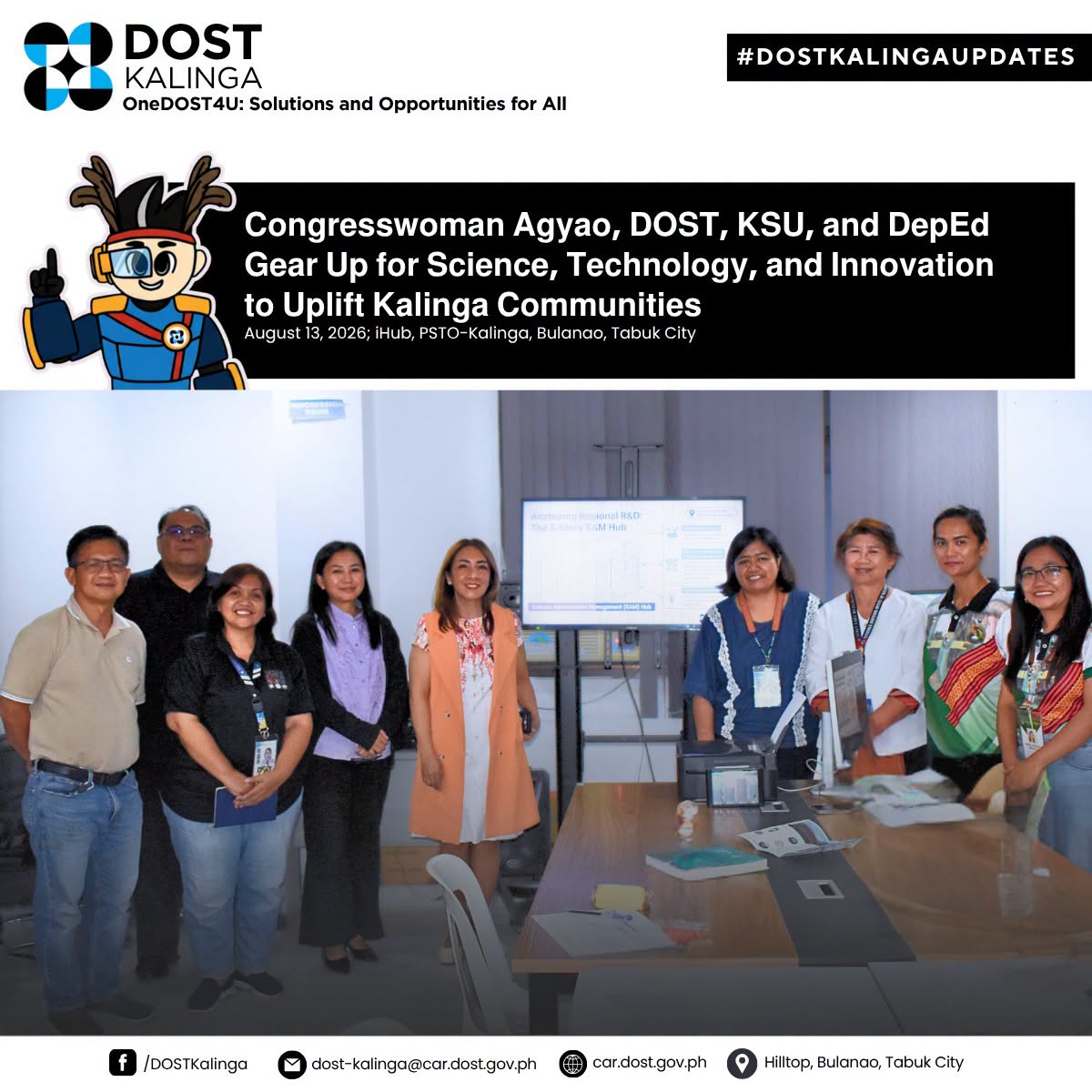
A coordination meeting was held on August 13, 2026, at the DOST-Kalinga iHub in Bulanao, Tabuk City, bringing together Congresswoman Caroline B. Agyao of the Lone District of Kalinga, Schools Division Superintendent Gloria B. Buya-ao of the Department of Education-Kalinga, and Dr. Karen Razelle M. Duyan, Faculty of the College of Entrepreneurship, Tourism, and Hospitality Management of Kalinga State University.
The activity was convened by the Provincial Science and Technology Office (PSTO)-Kalinga, led by Provincial Director Jasmin L. Donaal.
The meeting focused on strengthening collaboration among key stakeholders in advancing STI initiatives geared toward inclusive and sustainable development in the province.
Exploring the Potential of Abaca
One of the major highlights of the discussion was the proposed development and utilization of abaca, particularly its fiber.
Stakeholders explored the potential of establishing in-province processing capabilities to add value to raw abaca.
The initiative is envisioned to unlock additional economic opportunities for Kalinga communities while supporting the development of a more resilient and sustainable abaca industry.
The proposed effort could also create employment opportunities for graduating students and local stakeholders and support the growth of local enterprises.
From Raw Materials to Value Creation
The abaca discussion points to a broader opportunity in local economic development: creating more value from resources already available within communities.
Producing raw materials is only one part of a value chain. Processing, product development, manufacturing, packaging, marketing, and distribution can create additional opportunities for businesses and workers.
For Kalinga, developing local processing capabilities could potentially allow more activities connected to the abaca value chain to take place within the province.
This could open opportunities for entrepreneurs to develop products and services around the industry while creating additional demand for technical, business, and creative skills.
The proposal is still being developed, so its eventual impact will depend on how the initiative is further assessed and implemented.

Connecting Education, Research, and Enterprise
The participation of Kalinga State University and DepEd-Kalinga also highlights the role of education in supporting local innovation and economic development.
Universities can contribute research and technical expertise, while schools help develop the skills and capabilities of future workers and entrepreneurs.
For students and graduates, local industry development can create opportunities to apply their knowledge to real-world challenges.
This creates a potential connection between:
Education → Research → Technology → Enterprise → Employment
When these elements are connected, local development initiatives can create opportunities that extend beyond a single project.
Why This Matters for Northern Luzon
The discussion in Kalinga is relevant to the wider Northern Luzon innovation ecosystem, where provinces are working to strengthen local industries and create more opportunities around their existing resources.
Northern Luzon has diverse agricultural products, natural resources, universities, research institutions, and communities with specialized knowledge.
The challenge is not simply identifying these resources. It is finding ways to increase the value generated from them.
Kalinga’s proposed abaca processing initiative illustrates one possible approach.
By connecting a local resource with science and technology, education, entrepreneurship, and potential markets, a traditional commodity can potentially become the foundation for new products, enterprises, and employment opportunities.
The Role of Innovation in Local Industries
Innovation does not always mean developing an entirely new technology.
It can also mean finding better ways to process an existing resource, improving production, developing new products, reducing waste, creating more efficient systems, or finding new markets.
This perspective is particularly relevant for provinces where agriculture and natural resources remain important parts of the local economy.
The opportunity is to combine existing local strengths with new knowledge and technology.
For Kalinga, the proposed abaca initiative could provide a platform for this kind of approach if the necessary technical, economic, and market conditions are established.
From Coordination to Implementation
The August 13 meeting is an early step in developing these initiatives.
The participating stakeholders committed to further refine the proposed initiatives and work collaboratively toward STI-driven and inclusive development in Kalinga.
For the proposed abaca processing initiative, the next stages would need to establish how the concept can work in practice.
This includes understanding the available raw material supply, determining appropriate processing capabilities, identifying potential markets, assessing investment requirements, and defining how local farmers, entrepreneurs, students, and other stakeholders can participate.
These considerations will be important in determining whether the proposed opportunity can develop into a sustainable local industry.
Building a Stronger Innovation Ecosystem
The meeting also demonstrates why collaboration matters in regional innovation.
Government brings policy support and development programs.
Science and technology institutions provide technical capabilities.
Universities contribute research, talent, and knowledge.
Schools help prepare future workers and innovators.
Entrepreneurs and local communities bring practical knowledge and the ability to develop and apply solutions.
When these actors work around a shared opportunity, innovation can become more connected to actual community needs.
For Kalinga, the proposed abaca initiative could become one example of how these relationships can be developed around a local economic opportunity.
What This Means for Northern Luzon
For the broader Northern Luzon ecosystem, the opportunity is to look at local resources not simply as commodities, but as potential starting points for innovation and enterprise development.
The pathway can look something like:
Local Resource → Research and Technology → Value Addition → Enterprise → Market → Jobs
The process is not automatic. It requires validation, investment, appropriate technology, market development, and sustained collaboration.
But this is where regional innovation ecosystems can play an important role.
They can help connect researchers with communities, entrepreneurs with technologies, students with industry challenges, and local resources with new markets.
The Bigger Opportunity
Kalinga’s proposed abaca initiative is still being refined, but the discussion highlights a broader principle for local development.
The most valuable innovation opportunities may sometimes be found in resources that communities already have.
The question is how to combine those resources with technology, research, entrepreneurship, and market opportunities to create greater value locally.
For Kalinga, the next step is turning the initial coordination into concrete research, partnerships, and pilot activities that can determine what is technically feasible, economically viable, and beneficial to local communities.
For Northern Luzon, initiatives like this point toward a larger opportunity: building economies where local resources do not simply leave the province as raw materials, but can become the foundation for higher-value products, enterprises, and jobs.
Innovation does not always begin with inventing something new. Sometimes, it begins by looking at what a community already has and asking how much more value it can create.
Source
Market Context
For Northern Luzon, strengthening local value chains presents an opportunity to connect agriculture, science and technology, entrepreneurship, education, and employment.
The proposed abaca processing initiative in Kalinga is still at the development stage. Its eventual impact will depend on technical feasibility, available supply, market demand, investment, and the ability of stakeholders to build a sustainable local value chain.
What makes the initiative worth watching is its potential to move the conversation from producing raw materials to creating more value locally.
Are you a founder, innovator, or community builder in Northern Luzon?
We're always looking for compelling stories from the region's ecosystem. Whether you're launching a startup, running a program, or doing something interesting — we'd love to feature you.