
Baguio Expands Segregated Waste Collection Across Six Pilot Barangays, Opening Opportunities for Circular Innovation
Baguio City is expanding its segregated waste collection system to six pilot barangays, introducing separate collection schedules for biodegradable, recyclable, and residual waste. Beyond improving waste management, the initiative creates opportunities for entrepreneurs, innovators, and communities to develop solutions around recycling, circular economy, logistics, and waste data.
 Featured
Amianan Ventures
Six Barangays Begin Expanded Segregated Waste Collection
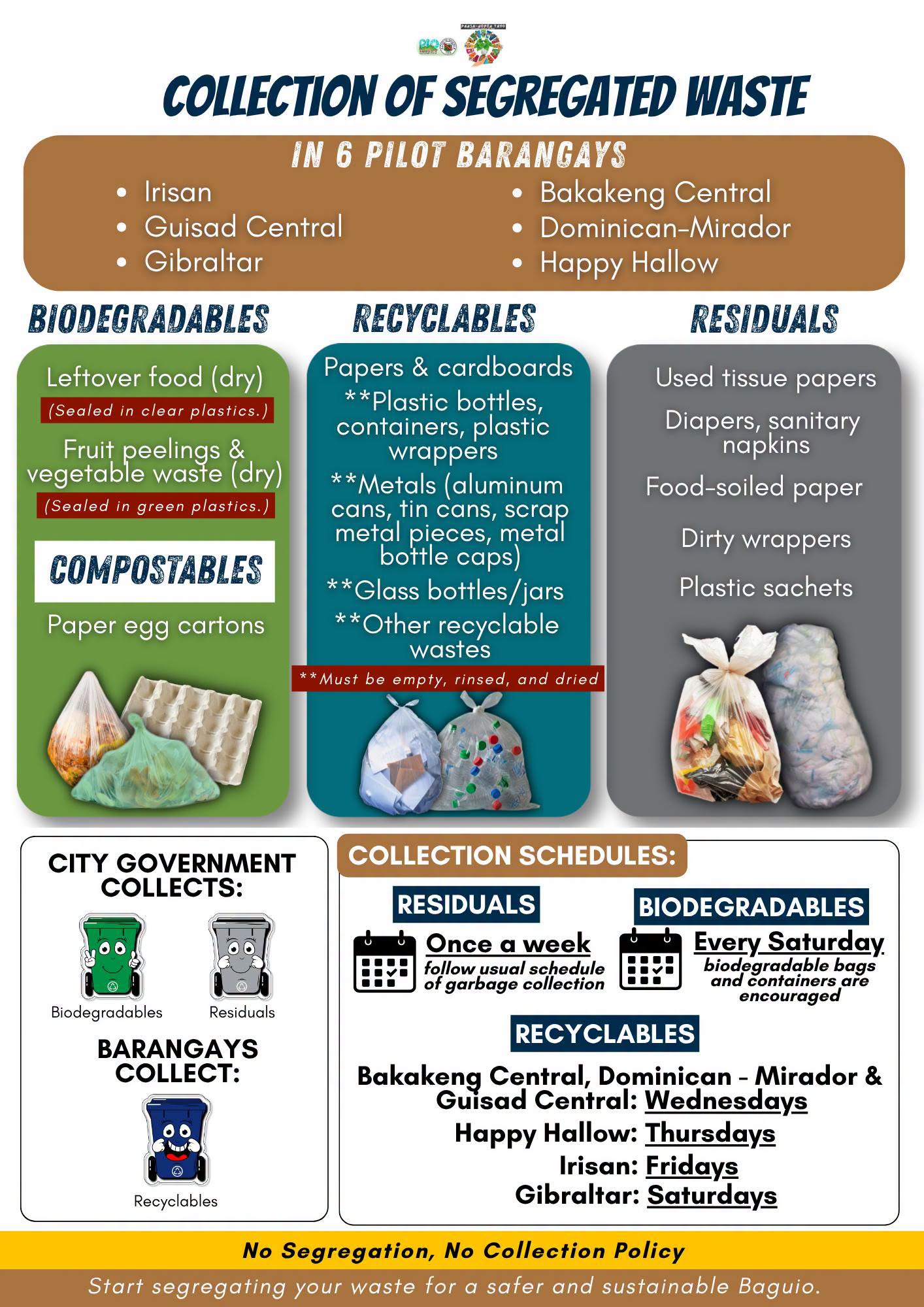
Six Baguio barangays are implementing a new garbage collection schedule as part of efforts to strengthen waste segregation at the community level.
The pilot barangays are:
Irisan
Guisad Central
Gibraltar
Bakakeng Central
Dominican-Mirador
Happy Hallow
The new collection schedule takes effect August 22, 2026, with residents reminded to segregate their waste at home before collection.
The “No Segregation, No Collection” policy will be strictly implemented in the participating barangays.
For other barangays, the usual garbage collection schedules remain in effect.
How the New System Works
The information released for the six pilot barangays separates waste into three main categories: biodegradables, recyclables, and residuals.
Biodegradable waste includes dry leftover food and fruit and vegetable waste, while compostable materials such as paper egg cartons are also identified.
Recyclables include:
Paper and cardboard
Plastic bottles and containers
Plastic wrappers
Metal cans and scrap metal
Glass bottles and jars
Other recyclable materials
The materials identified as recyclables must be empty, rinsed, and dried before collection.
Residual waste includes materials such as used tissue paper, diapers and sanitary napkins, food-soiled paper, dirty wrappers, and plastic sachets.
The collection schedule also varies by waste type.
Residuals: Once a week, following the usual garbage collection schedule.
Biodegradables: Every Saturday.
Recyclables:
Bakakeng Central, Dominican-Mirador, and Guisad Central: Wednesdays
Happy Hallow: Thursdays
Irisan: Fridays
Gibraltar: Saturdays
The system also identifies different collection responsibilities between the city government and barangays.
Why Waste Segregation Is More Than a Collection Issue
Waste segregation is often treated primarily as a matter of household discipline.
But a functioning segregation system is also an operational and innovation challenge.
Once waste is separated at the source, the system needs to answer a series of practical questions:
How should different waste streams be collected?
How can collection routes be optimized?
Where should recyclable materials go?
How can households be encouraged to consistently segregate?
How can recyclable materials be connected to buyers or processors?
How can local governments measure whether the system is actually working?
These questions create opportunities for technology, entrepreneurship, and community innovation.
A Potential Opportunity for Circular Economy Startups
The six-barangay pilot creates a real-world environment where entrepreneurs and innovators could explore solutions for the circular economy.
Potential areas include waste collection technology, recycling marketplaces, route optimization, segregation monitoring, community incentives, material recovery, and waste analytics.
For example, a technology solution could potentially help barangays monitor collection volumes by waste category.
Another could connect households, junk shops, recyclers, and material recovery facilities through a digital marketplace.
Entrepreneurs could also explore systems that reward households or communities for consistently segregating recyclable materials.
These are not necessarily solutions currently being implemented by the city. They represent potential innovation opportunities suggested by the operational challenges created by a segregated collection system.
Turning Waste Into Data
One particularly interesting opportunity is the role of data.
A segregated collection system can potentially generate information about:
The volume of biodegradable waste collected
The amount of recyclable materials recovered
Residual waste volumes
Collection frequency
Barangay-level participation
Commonly discarded materials
Changes in waste generation over time
With the appropriate systems and safeguards, this information could help local governments understand where interventions are working and where additional support is needed.
For innovators, this creates an opportunity to develop tools that transform waste collection from a largely manual process into a more measurable and data-informed public service.
From Waste Management to Circular Economy
There is also a larger economic opportunity.
Recyclable materials are not simply waste. They can become inputs into another production process.
This is the basic idea behind a circular economy: keeping materials in use for as long as possible rather than immediately sending them to disposal.
For Baguio and Northern Luzon, this could create opportunities across several parts of the value chain:
Households → Collection → Sorting → Recovery → Processing → New Products → Markets
Each stage can potentially create opportunities for businesses, cooperatives, social enterprises, and technology providers.
The challenge is building the connections between these stages.
Opportunities for Local Entrepreneurs
The shift toward better segregation can also create demand for practical products and services.
Potential areas for local entrepreneurship include:
Recycling and recovery
Businesses can explore ways to collect, process, and add value to recyclable materials.
Reusable and sustainable packaging
Local businesses can develop alternatives that reduce dependence on disposable materials.
Waste logistics
Technology can potentially improve collection routing, scheduling, and coordination.
Community incentives
Digital platforms could potentially create mechanisms that encourage households and establishments to participate consistently.
Waste education
There is also room for services and products that make waste segregation easier to understand for households, schools, businesses, and communities.
The strongest opportunities will likely be those that solve a specific operational problem while creating measurable environmental and economic value.
A Living Laboratory for Innovation
The six pilot barangays could also function as a useful environment for testing solutions.
Instead of developing waste-management technologies in isolation, innovators can potentially work with communities and local government to understand actual behavior, operational constraints, and user needs.
This is where an innovation approach becomes important.
Start with the problem.
Observe how people currently behave.
Identify the biggest friction points.
Develop a small solution.
Test it in the real environment.
Measure the results.
Improve it based on evidence.
This approach can help prevent the common mistake of building technology before understanding the problem.
What This Means for Northern Luzon
Baguio’s waste challenge is not unique to the city.
Cities and municipalities across Northern Luzon face similar questions around waste generation, segregation, collection, recycling, and disposal.
This makes local pilots potentially valuable beyond their immediate communities.
If new approaches can demonstrate better participation, lower residual waste, more efficient collection, or stronger recovery of recyclable materials, they may provide lessons that can inform similar initiatives elsewhere in the region.
For the Northern Luzon innovation ecosystem, this also creates a category of problems that researchers, students, startups, MSMEs, and civic innovators can work on together.
The Bigger Opportunity Is Not Just Collecting Less Waste
The goal of segregation should not simply be to make garbage collection more organized.
The bigger opportunity is to rethink what happens to materials after they leave households.
Can more materials be recovered?
Can recyclable waste become an economic resource?
Can collection become more efficient?
Can communities be given better incentives?
Can data help cities make better decisions?
And can local entrepreneurs build businesses around solving these problems?
These questions move the conversation from waste disposal to resource management.
From Pilot Program to Innovation Opportunity
The implementation across six barangays provides a concrete starting point.
For government, the immediate priority is getting the collection system to work.
For communities, the priority is participating in proper segregation.
For innovators and entrepreneurs, however, the emerging opportunity is to look at the gaps around the system and ask:
What can we build that makes segregation easier, collection smarter, recovery more valuable, and communities more sustainable?
That is where a public-service challenge can become an innovation opportunity.
Baguio’s segregated waste collection pilot is ultimately more than a change in garbage schedules. It is an opportunity to explore how government, communities, researchers, entrepreneurs, and technology providers can work together to build a more circular local economy.
Original Source
Market Context
Waste management is increasingly becoming an area for innovation across the circular economy, particularly in waste recovery, logistics, recycling, resource efficiency, and data-driven public services.
For Baguio and Northern Luzon, local waste-management challenges can provide practical problem spaces for students, researchers, startups, MSMEs, and social enterprises. The most promising solutions will likely be those that are affordable, locally adaptable, and capable of demonstrating measurable improvements in collection efficiency, material recovery, community participation, or environmental outcomes.
Are you a founder, innovator, or community builder in Northern Luzon?
We're always looking for compelling stories from the region's ecosystem. Whether you're launching a startup, running a program, or doing something interesting — we'd love to feature you.