
SILLAG Region 1 Strengthens Startup Mentors Through Problem Identification and Idea Validation Training
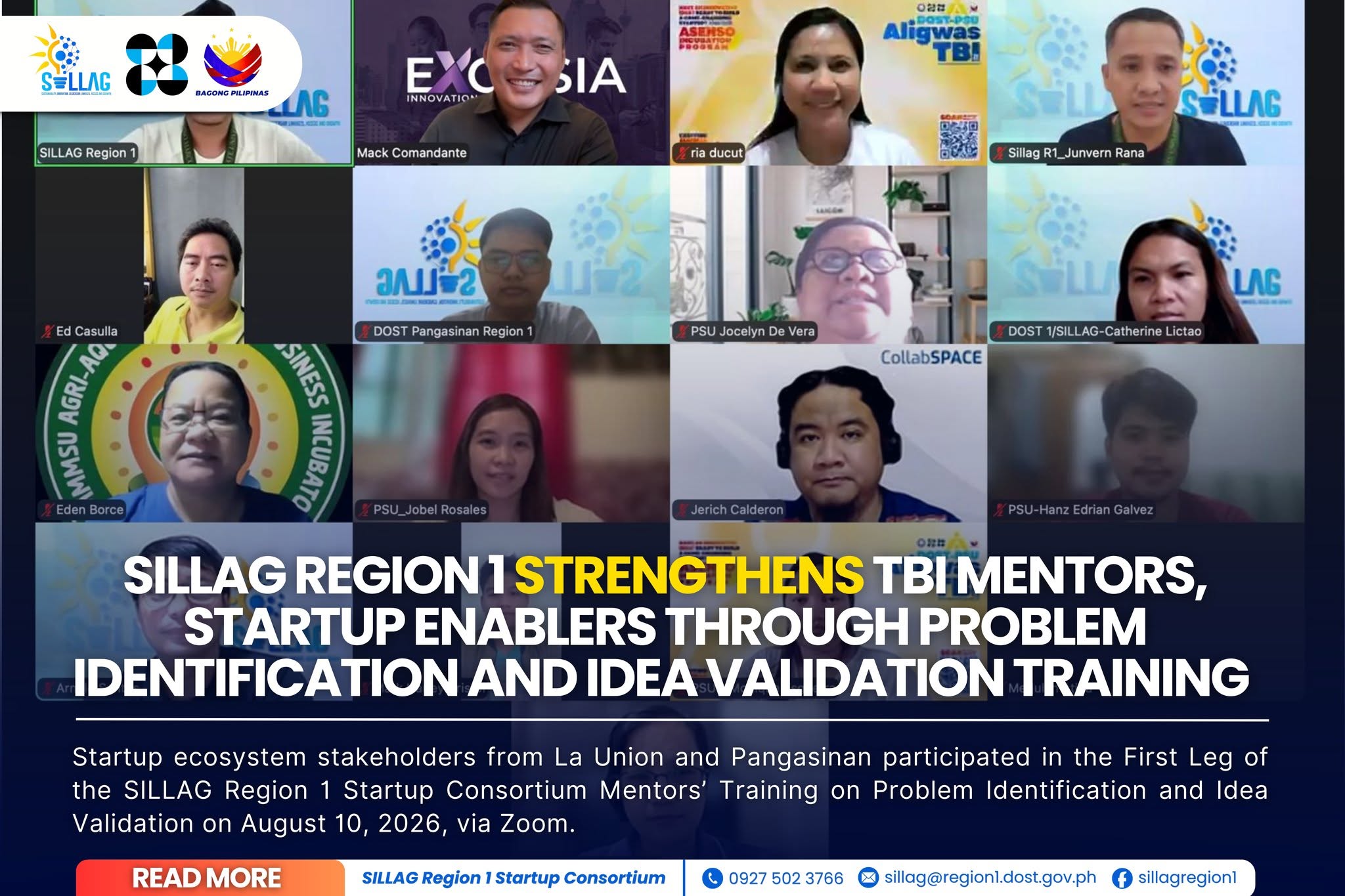
The first leg of the SILLAG Region 1 Startup Consortium Mentors’ Training brought together 51 mentors, coaches, and startup ecosystem enablers from La Union and Pangasinan to strengthen their ability to guide technology-based startups in identifying meaningful problems, validating ideas, and developing ventures toward investment readiness.
 Featured Partner
Inv8 Studio
Innovation Partner for Startups & Growing Businesses
Strengthening the People Behind the Startup Ecosystem
Startup founders are often the most visible part of an innovation ecosystem. Behind them, however, is a network of mentors, coaches, incubators, and ecosystem organizations that help founders navigate the difficult journey from idea to venture.
Recognizing the importance of these support structures, the SILLAG Region 1 Startup Consortium conducted its first leg of the Mentors’ Training on Problem Identification and Idea Validation on August 10, 2026, via Zoom.
The activity brought together 51 mentors, coaches, and facilitators from Technology Business Incubators (TBIs) and private startup-enabling organizations in La Union and Pangasinan.
Participants from La Union included representatives from Don Mariano Marcos Memorial State University–Agri-Aqua TBI and Collabspace, while Pangasinan was represented by DOST-PSU Aligwas TBI, Makerspace InnovHub, and United Professionals for Innovation and Convergence of Technologies (UPICT).
The training focused on strengthening the capacity of these ecosystem enablers to provide more effective guidance to technology-based startups and aspiring entrepreneurs.
Why Problem Identification Comes First
One of the most important lessons in startup development is that a startup should not begin with a solution alone.
It should begin with a problem worth solving.
Founders can spend months building a product only to discover that customers do not consider the problem important enough, already have alternative solutions, or are unwilling to pay for a better solution.
This makes problem identification and validation critical skills for both founders and the people mentoring them.
For startup mentors, the challenge is not simply to encourage founders.
It is to ask the right questions.
Is the problem real?
Who experiences it?
How frequently does it happen?
How are people solving it today?
What assumptions are being made?
And what evidence is needed before investing more time and resources into the idea?
Developing mentors who can facilitate these conversations can strengthen the quality of support available to startups across the region.
Practical Tools for Startup Mentoring
The training was facilitated by Mr. Mark Philip Comandante, Chief Executive Officer of ExoAsia Innovation Hub, who introduced participants to several tools that can support startup development and validation.
These included:
Experiment Card
Business Model Canvas
ExO Canvas
Pitch Canvas
Systemic Canvas
Value Proposition Canvas
Rather than treating these tools simply as templates, their value comes from how they help founders and mentors structure conversations around customers, assumptions, business models, opportunities, and value creation.
For mentors, having a common set of frameworks can also create a more consistent approach to supporting startups across different incubation programs.
Moving From Ideas to Evidence
Idea validation is fundamentally about reducing uncertainty.
A founder may believe that a particular customer has a problem. Validation asks whether there is evidence to support that belief.
This can involve conversations with potential users, experiments, prototypes, market testing, or other forms of evidence gathering.
The role of the mentor is important because founders can become attached to their own ideas.
A good mentor can help create enough distance for the founder to challenge assumptions without losing momentum.
This is particularly important for technology-based startups, where technical feasibility can sometimes overshadow customer needs and market realities.
A technology may work.
The bigger question is whether someone actually needs it.
Building Stronger Startup Support Across Region 1
The participating organizations represent different parts of the startup support landscape in La Union and Pangasinan.
Bringing these organizations together creates opportunities not only for capacity building but also for knowledge sharing and stronger coordination among ecosystem actors.
For Region 1, this matters because startups do not operate within the boundaries of a single institution.
A founder may need access to research facilities from a university, technical support from an incubator, business mentoring from an ecosystem organization, financing from investors, and market connections from industry.
A stronger network of startup enablers can help make these connections easier to navigate.
From Mentors to Ecosystem Enablers
The distinction between being a mentor and being an ecosystem enabler is important.
A mentor may help one founder solve a specific challenge.
An ecosystem enabler helps create the conditions where many founders can access the people, knowledge, infrastructure, opportunities, and institutions they need.
This means capacity building for startup support organizations can have a multiplier effect.
Training 51 mentors and ecosystem practitioners does not simply benefit 51 individuals.
If these participants apply what they learn in their respective TBIs and organizations, the knowledge can eventually reach a much larger number of founders and aspiring entrepreneurs.
The Next Leg Expands the Network
The SILLAG Region 1 capacity-building initiative will continue with a second leg later this month.
The next training will extend to TBI enablers from Ilocos Norte and Ilocos Sur, further expanding participation across Region 1.
This creates an opportunity to develop a broader network of startup mentors and ecosystem support providers across the region.
The long-term value of such a network will depend not only on the number of people trained, but on how effectively they apply the frameworks, share knowledge, and collaborate in supporting entrepreneurs.
Building Better Pathways for Regional Startups
For emerging startup ecosystems outside major innovation centers, developing strong local support systems is essential.
Founders need more than programs that help them start.
They need support to understand customers, validate opportunities, build sustainable business models, develop products, access markets, and eventually become investment-ready.
That requires capable mentors and connected ecosystem organizations.
The SILLAG Region 1 training is one step toward strengthening that layer of the ecosystem.
Its focus on problem identification and idea validation is particularly relevant because these are foundational capabilities for building startups that solve meaningful problems rather than simply developing technologies in search of a market.
The Bigger Opportunity for Region 1
Region 1 has universities, technology business incubators, innovation organizations, researchers, entrepreneurs, and industry stakeholders that can contribute to a stronger startup ecosystem.
The opportunity now is to connect these capabilities more effectively.
A stronger regional startup pipeline could look like:
Problem Identification → Idea Validation → Prototype → Market Validation → Venture Development → Investment Readiness
Mentors and startup enablers play an important role at every stage.
The quality of that support can influence whether promising ideas remain ideas or develop into viable ventures.
For Region 1, strengthening the people who support entrepreneurs may ultimately be just as important as supporting the entrepreneurs themselves.
Original Source
Market Context
Startup ecosystems depend not only on founders and funding but also on the quality of the support infrastructure surrounding entrepreneurs. Mentors, incubators, coaches, universities, and ecosystem organizations help founders navigate uncertainty, validate assumptions, and access resources.
For Northern Luzon and Region 1, strengthening this network can help create more consistent pathways for technology-based startups to move from early ideas toward validation, venture development, and investment readiness. The expansion of the SILLAG training to Ilocos Norte and Ilocos Sur also points toward a broader regional network of startup support providers.
Are you a founder, innovator, or community builder in Northern Luzon?
We're always looking for compelling stories from the region's ecosystem. Whether you're launching a startup, running a program, or doing something interesting — we'd love to feature you.