
Region I Innovators Push Agri-Aqua Technologies Closer to the Market Through RAISE Forward 2026
Technology-transfer leaders and innovators from Region I joined RAISE Forward 2026 to strengthen pathways for agricultural and aquatic research to reach investors, industry partners, and potential adopters. The summit highlighted how technology incubation, intellectual property management, commercialization, and startup development can help turn research outputs into viable enterprises for Northern Luzon.
 Featured
Amianan Ventures
From Research to Real-World Applications
Agricultural research can create valuable technologies, but developing the technology is only one part of the journey.
The bigger challenge is bringing those technologies closer to the people and businesses that can use them.
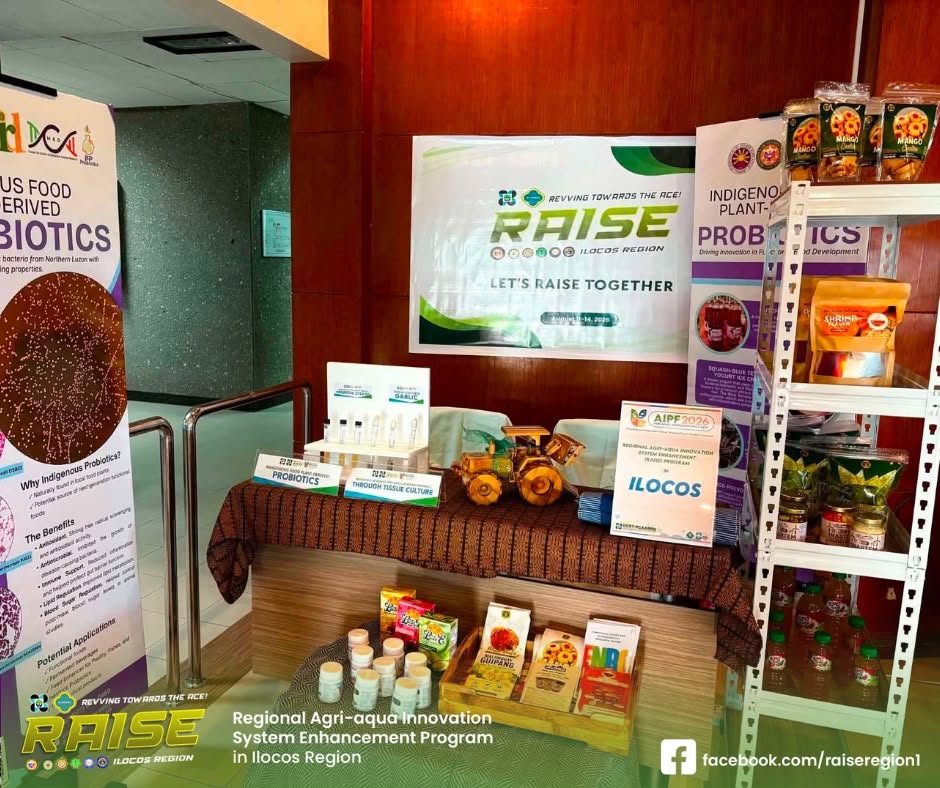
This was one of the key themes behind the participation of Region I representatives in RAISE Forward 2026, held from August 11 to 14, 2026, at the DOST-PCAARRD Headquarters in Los Baños, Laguna.
The summit brought together technology-transfer leaders and implementers working to strengthen the connection between research, innovation, entrepreneurship, and commercialization.
For Region I, the participation of institutions such as Mariano Marcos State University (MMSU) and Don Mariano Marcos Memorial State University (DMMMSU) highlights the growing importance of technology transfer in turning academic research into solutions with economic and social value.
Creating Pathways for Agri-Aqua Innovation
The Region I delegation was led by Dr. Nathaniel R. Alibuyog, MMSU Vice President for Research, Development, and Innovation, together with Dr. Dionisio S. Bucao, RAISE Region I Program Leader and Project Leader for Regional Intellectual Property and Technology Business Management.
They were joined by Prof. Victoria Malaya, Assistant Program Leader for RAISE Region I and Project Leader for DMMMSU’s Regional Agri-Aqua Technology Business Incubation (ATBI); Prof. Ethel Reynda M. Calivoso, Project Leader for the Regional Agribusiness Hub; and Dr. Love Grace D. Campano, Project Leader for the Regional Knowledge Management Hub.
Their participation reflects a broader shift in how universities can contribute to regional economic development.
Research does not have to remain inside laboratories, academic publications, or institutional reports.
With the right support, research outputs can become prototypes, technologies, businesses, and solutions that reach farmers, fisherfolk, agribusinesses, and consumers.
The Pitching Fest: Where Technologies Meet the Market
The summit opened on August 11 with the 3rd Agri-Aqua Innovation Pitching Fest (AIPF) 2026.
The pitching event provided regional innovators with an opportunity to present high-potential technologies directly to investors, industry leaders, and prospective adopters.
This is an important part of the innovation journey.
A technology may be technically viable, but commercialization requires more questions to be answered:
Who needs it?
What problem does it solve?
Who will pay for it?
Can it be produced at scale?
What partnerships are required?
Can the technology create enough value to justify adoption?
Pitching events create a space where innovators can begin answering these questions while connecting with people who may help move the technology forward.
Region I Startup Earns Recognition
One of the highlights for the region was the performance of ElDiCa Seafood Processing, a DMMMSU Agri-Aqua Technology Business Incubator (ATBI) incubatee and licensee.
The enterprise earned 3rd Best Pitch in Category A: Products/Technologies from Startups for its value-added processed milkfish, or bangus, products.
The recognition is significant because it demonstrates one possible pathway from university-supported innovation toward entrepreneurship.
Research and technology can provide the foundation.
Incubation can provide support.
Entrepreneurship can turn the technology into a business.
And market connections can create opportunities for the solution to reach customers.
This is the type of pipeline that regional innovation ecosystems need to strengthen.
Why Technology Transfer Matters for Startups
For many startups, especially those emerging from universities, the biggest challenge is not necessarily the lack of ideas.
It is the gap between having a promising technology and building a viable business around it.
Technology transfer mechanisms can help bridge this gap.
Intellectual property management can help protect and organize research outputs.
Technology business incubation can provide entrepreneurs with guidance and business support.
Market linkage can connect technologies with potential customers and adopters.
Mentorship can help researchers and founders understand commercial requirements.
Together, these mechanisms can make it easier for promising technologies to move from the laboratory toward the market.
Beyond the Prototype
One of the important lessons from technology commercialization is that a prototype is not the finish line.
A working prototype demonstrates that something can be built.
A viable enterprise needs to demonstrate that people actually want it, that it can be delivered effectively, and that there is a sustainable business model behind it.
This is where technology-based startups can benefit from combining technical expertise with entrepreneurial capabilities.
Researchers understand the technology.
Entrepreneurs understand customers and markets.
Industry partners understand operational realities.
Investors understand capital requirements and growth potential.
A strong innovation ecosystem brings these perspectives together.
Building Sustainable Technology Transfer Systems
Following the pitching activities, the focus of RAISE Forward 2026 shifted toward long-term sustainability.
On August 12 and 13, participants took part in the RAISE Program Sustainability Planning Workshop.
The workshop focused on understanding the current state of technology-transfer initiatives, identifying priorities, developing performance metrics, and shaping sustainability goals and implementation plans.
This is particularly important because innovation programs should not depend solely on temporary funding or short-term activities.
For technology transfer to create lasting impact, institutions need sustainable systems that can continue supporting researchers, innovators, and entrepreneurs beyond individual projects.
The question becomes not only:
“What technologies can we commercialize?”
but also:
“What systems do we need to consistently move technologies toward adoption?”
The Role of University-Based Incubation
University-based incubators can play a critical role in this process.
They provide a bridge between research institutions and entrepreneurship by helping researchers and innovators explore whether their technologies can become viable products or businesses.
For Northern Luzon, this can be particularly valuable in sectors closely connected to the region’s economy.
Agriculture, fisheries, food processing, textiles, tourism, and other local industries can benefit from technologies developed within universities and research institutions.
But technology alone is not enough.
The innovation ecosystem must also provide pathways for validation, business development, intellectual property management, financing, market access, and commercialization.
From Regional Research to Regional Enterprises
The participation of Region I in RAISE Forward 2026 points toward a larger opportunity.
The region has universities, researchers, technology business incubators, entrepreneurs, agricultural communities, and industry stakeholders.
The opportunity is to connect these assets more effectively.
A possible pathway looks like this:
Research → Intellectual Property → Prototype → Validation → Incubation → Commercialization → Market
Each stage requires different capabilities.
Researchers may lead the early technology development.
Technology-transfer offices can help manage intellectual property and commercialization pathways.
Incubators can support venture development.
Industry partners can provide market knowledge and adoption opportunities.
Entrepreneurs can help transform technologies into products and businesses.
Investors can provide capital for growth.
When these pieces connect, research can have a much greater chance of creating real-world impact.
The Bigger Opportunity for Northern Luzon
For Northern Luzon, strengthening technology commercialization is not simply about creating more startups.
It is also about strengthening local industries.
A technology that improves agricultural productivity can help farmers.
A food-processing innovation can create new products and businesses.
A new production technology can improve the competitiveness of local enterprises.
A university-developed solution can become a technology adopted by an industry partner.
In this sense, technology transfer becomes an economic development tool.
The goal is not to commercialize every research output.
The goal is to identify promising technologies and give them a pathway to determine whether they can create meaningful value.
What RAISE Forward 2026 Signals for the Startup Ecosystem
The RAISE Forward 2026 experience highlights an important shift in regional innovation.
The conversation is moving beyond “What can we invent?” toward “How do we make useful innovations reach the people who need them?”
That shift is critical for building stronger startup ecosystems.
Startups can become vehicles for commercializing technologies.
Universities can become sources of both talent and intellectual property.
Incubators can help bridge research and entrepreneurship.
Industry can provide real-world problems and market opportunities.
Government programs can help create the infrastructure and support systems needed to make these connections possible.
When these players work together, innovation becomes less about isolated projects and more about building a continuous pipeline.
The Next Step Is Commercialization
RAISE Forward 2026 concluded on August 14 with the Progress Review for RAISE Program Batch 1, Phase 2, focused on reviewing achievements, addressing operational bottlenecks, and refining action plans for ongoing initiatives.
For Region I, the larger objective remains clear: strengthen the ability of regional research and technologies to become viable commercial enterprises that can support farmers, fisherfolk, agribusinesses, and local communities.
The recognition of ElDiCa Seafood Processing also provides a practical example of what this pathway can look like.
An innovation ecosystem becomes meaningful when an idea can move beyond the institution where it was created.
When it can become a product.
When a product can become a business.
And when that business can create value for communities.
For Northern Luzon, strengthening this pipeline could help ensure that more of the region’s research, technology, and entrepreneurial talent contribute directly to inclusive economic growth.
Original Source
The source identified representatives from Mariano Marcos State University (MMSU), Don Mariano Marcos Memorial State University (DMMMSU), and the RAISE Region I program, as well as the participation of ElDiCa Seafood Processing in the 3rd Agri-Aqua Innovation Pitching Fest 2026.
The discussion on startup development, technology commercialization, and innovation ecosystem pathways is editorial analysis based on the activities and roles described in the source and is not presented as a specific commitment by the participating institutions.
Market Context
For Northern Luzon, university-based technology transfer and incubation can become important mechanisms for connecting research with local economic opportunities.
Agriculture and aquaculture remain closely connected to many regional communities, creating opportunities for technologies that improve production, processing, logistics, sustainability, and market access.
However, moving research into the market requires more than technical development. It requires intellectual property support, validation, business development, incubation, industry partnerships, financing, and market access.
Programs such as RAISE can help strengthen these connections by creating pathways where promising research outputs can be assessed not only for their technical potential, but also for their potential to become products, technologies, enterprises, or solutions that create value for Northern Luzon communities.
Are you a founder, innovator, or community builder in Northern Luzon?
We're always looking for compelling stories from the region's ecosystem. Whether you're launching a startup, running a program, or doing something interesting — we'd love to feature you.