
Kalinga Is Turning Taro Into a Business. Here Is How 20 Residents in Lubuagan Learned to Do It.
DTI Kalinga's Negosyo Center Lubuagan held a hands-on livelihood training on April 30, 2026, showing participants how a locally grown root crop can become a packaged, market-ready product — with the costing and pricing knowledge to sustain it.
 Featured
Amianan Ventures
Taro grows in Kalinga. It always has. What it has not always had is a clear path from the ground to a shelf, a label, and a selling price that makes sense.
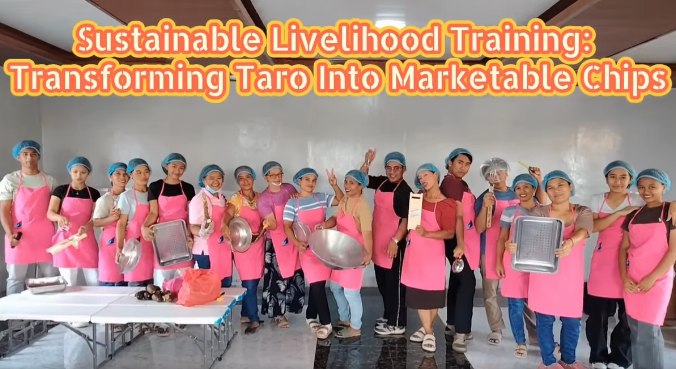
On April 30, 2026, DTI Kalinga through its Negosyo Center Lubuagan brought 20 participants together at the Poblacion Barangay Hall in Lubuagan, Kalinga for a Sustainable Livelihood Training focused on exactly that: transforming taro into marketable chips. The activity was not a lecture series. It was a full production walkthrough — from raw material to finished, packaged product — designed to leave participants with skills they could act on the following day.
What the Training Covered
The technical sessions were led by Ms. Wilma Alvester, owner of FLQ Food Products and a practicing entrepreneur with direct experience building a food enterprise from the ground up. Her role was not just to teach the process — it was to show participants that the process had already worked for someone who started the same way they were starting.
Her session covered the full taro chips production chain: understanding taro's value and market potential as a raw material, proper slicing techniques, frying methods, flavoring, and packaging practices. A hands-on demonstration ran alongside the lecture, putting participants in direct contact with each stage of production rather than leaving them with theory alone.
Ms. Alvester was deliberate about one area that training programmes often treat as secondary: quality control and packaging. How a product looks, how long it lasts, and whether it meets food safety standards are not finishing touches — they are the factors that determine whether a customer picks it up a second time. She framed packaging not as aesthetics but as market strategy.
The Business Side: Costing, Pricing, and Knowing Your Numbers
Technical skills get a product made. Business skills get it sold sustainably. Ms. Glecy Grace M. Dugauiwe, NC TIDS, handled the second half of the training with a focused session on product costing and pricing — the fundamentals that most first-time food entrepreneurs skip until they are already losing money.
Her discussion walked participants through the components of production cost: direct materials, labor, overhead, and desired profit margin. More importantly, it gave participants a method — a way to compute a selling price that is competitive in the market without undercutting their own livelihood. This is the kind of financial grounding that separates a one-time batch from a repeatable business.
Mr. Reynald D. Salpad closed the formal sessions with an orientation on the Client Satisfaction Form, guiding participants through the feedback process and explaining how their inputs directly shape the design of future programmes.
What It Means Beyond the Training Room
Lubuagan is a municipality in the interior of Kalinga — not a commercial center, not a regional hub, but a community with natural resources, motivated residents, and the same fundamental need as every other community in the Cordillera: a pathway from what they grow to what they can earn.
Taro is abundant. The knowledge of how to process it, package it, price it, and bring it to market is not always available locally. That gap is precisely what Negosyo Centers are designed to close — not by bringing in outside products, but by helping communities build enterprises from what they already have.
The twenty participants who walked out of Poblacion Barangay Hall on April 30 left with more than a recipe. They left with a production process, a pricing framework, and the firsthand experience of an entrepreneur who built something real from a similar starting point. That combination — technical skill, business knowledge, and proof that it can be done — is the foundation a livelihood programme is supposed to lay.
Source: DTI Kalinga | Negosyo Center Lubuagan | Activity conducted April 30, 2026
Are you a founder, innovator, or community builder in Northern Luzon?
We're always looking for compelling stories from the region's ecosystem. Whether you're launching a startup, running a program, or doing something interesting — we'd love to feature you.