
For the Millions, Not the Millionaires — How Alam Mo Ba Baguio Is Giving Baguio's Small Businesses the Visibility They Were Never Getting
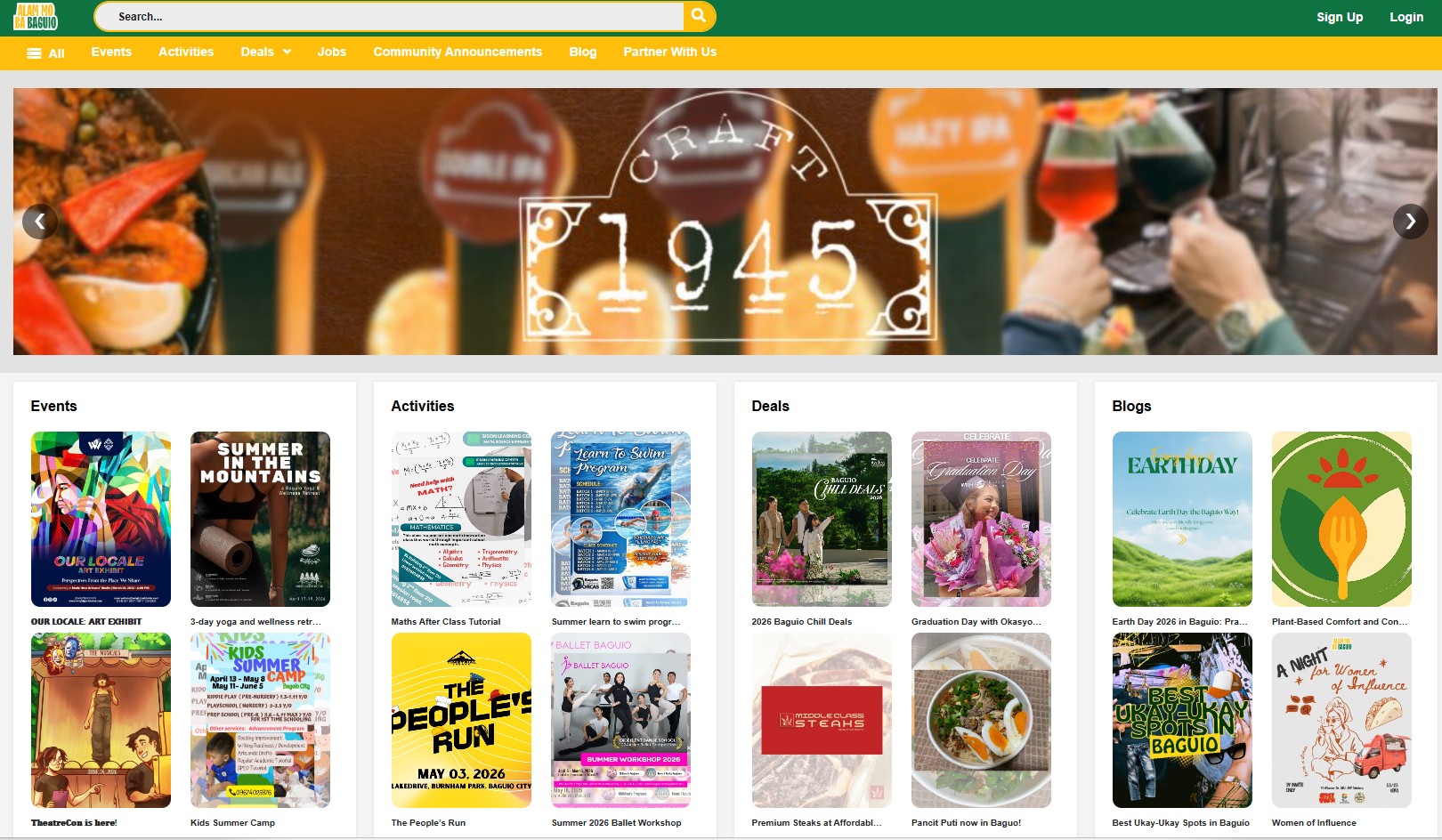
Josh Inman and co-founder Karen Perez launched Alam Mo Ba Baguio in November 2025 to solve a problem they lived personally — and in six months, the platform has clocked over 60,000 unique visits and advertised more than 1,000 events, activities, and deals from Baguio's small business community.
 Featured
Amianan Ventures
It started with a Friday night problem.
Together, Josh and Karen wanted to know what was happening in Baguio. Not a specific event they had already heard about — just what the city had going on that evening. And they could not find out without opening multiple apps, scrolling through feeds built by algorithms designed for engagement rather than discovery, and following every venue separately on every platform just to piece together a picture of what was available.
Baguio has 23,000 businesses. Thousands of events, activities, promos, and experiences on offer at any given time. And no single place to find them. That gap — obvious once you notice it, invisible until you do — became Alam Mo Ba Baguio.

The Problem They Are Solving
Social media algorithms are built for scale. They amplify what is already popular, reward accounts with large followings and paid budgets, and systematically underexpose smaller businesses that cannot afford to compete in a pay-to-play advertising environment. For a city like Baguio — dense with independent restaurants, creative studios, event venues, cultural festivals, and community organizations — that invisibility has real economic consequences. A great event goes half-attended. A small business runs a promo that nobody sees. A job vacancy sits unfilled because the post never reached the right person.
"Noisy algorithms on social media platforms hide smaller businesses, which holds back growth and opportunity," Josh says. "We seek to democratise advertising space — for the millions, not the millionaires."
That framing is the product's north star. Alam Mo Ba Baguio is not trying to out-compete Facebook or Instagram. It is building the layer underneath — the aggregator that surfaces what the algorithm buries, the discovery tool that works for the city rather than for the platform.
What They Built
Alam Mo Ba Baguio officially launched its website in November 2025. In its first six months, the platform recorded over 60,000 unique site visits and helped advertise more than 1,000 events, activities, and deals from Baguio's small business community. Website banners — the platform's first premium ad product — are now generating over 10,000 unique views per month, giving early adopter businesses a return on a product that costs a fraction of what traditional digital advertising demands.
The platform's model is deliberately accessible. Most advertising is free. Premium options — website banners, blog or vlog features, and a weekly social media reel — are priced at the low end by design. The goal is not to extract maximum margin from businesses already operating on thin margins. It is to build a platform valuable enough that a fraction of the city's businesses would pay for it — and to do that, it first had to be genuinely useful to all of them for free.
Beyond digital advertising, Alam Mo Ba Baguio has put its name behind the city's creative culture directly — sponsoring events like the Habing Katutubo and Soulstice fashion shows, and music festivals including Salidummay, Sound Summit, and Chill and Chili Music Festival. These are not just marketing activities. They are the platform's proof of commitment to the community it is building for.
The Hard Part Nobody Warns You About
"Advertising an advertising platform is a tricky sell," Josh says plainly.
The chicken-and-egg problem is real. Businesses pay for audiences. Audiences come for content. Content requires businesses. In the early months, Josh and Karen funded the platform from personal savings, building the audience before the revenue case existed — because that is the only order in which it could be done.
What got them through it was conviction in the numbers. Baguio's daytime population pushes toward one million people. The city receives approximately 1.5 million visitors annually. A platform that captures even a fraction of that discovery traffic has a viable business underneath it. "Even if it were to capture 0.1% of that enormous potential audience," Josh says, "the growth potential is massive."
That clarity of market thinking — knowing exactly what makes the platform defensible even in its earliest, smallest form — is what kept the build moving through the hard months.
What He Is Building Toward
Alam Mo Ba Baguio has already provided advertising space to over 350 Baguio-based organizations and businesses. By November 2026 — the platform's first anniversary — Josh wants that number at 1,000. The next phase is also broader in scope: expanding from consumer-to-business connections into community infrastructure, using the platform not just to surface events but to build the connective tissue between Baguio's organizations, creative communities, and the people who live and visit here.
His advice for every other founder building in the region cuts through the noise the same way his platform does.
"Network and collaborate. Baguio is full of startups and hopeful entrepreneurs — uplift each other rather than seeing them as competition. The pie is huge. There is plenty to share."
What Other Founders Can Learn From This
Lesson 1 — The best startup ideas are the ones that annoy you first.
Joshand Karen did not sit down to map a market opportunity. They tried to find out what was happening on a Friday night and hit a wall. That friction — personal, specific, and repeated — is exactly where the best product ideas live. If a problem is bothering you regularly, it is bothering thousands of other people too. The founders who build the most useful things are often the ones who got frustrated enough to stop waiting for someone else to fix it.
Don't overthink the origin of your idea. If you keep running into the same problem, that problem is your brief.
Lesson 2 — Free is a strategy, not a weakness.
Alam Mo Ba Baguio made most of its advertising free from day one — not because the team did not know how to charge, but because they understood that a platform with no audience has nothing to sell. They had to build the value before they could monetize it. That discipline — resisting the temptation to charge too early, investing in usefulness first — is what created the foundation for premium products that businesses actually want to pay for. Sixty thousand unique visits and 10,000 monthly banner views did not happen by accident. They happened because the platform gave value before it asked for anything in return.
Your early users are not your customers yet. They are your proof of concept. Treat them accordingly and the paying customers will follow.
Lesson 3 — Your competitors are not the other startups in your city.
Josh's advice to founders is direct: network, collaborate, and uplift rather than compete. In a city like Baguio — with a daytime population approaching one million and 1.5 million annual visitors — the addressable market is enormous relative to the number of businesses and platforms trying to serve it. The scarcity mindset that turns founders against each other is almost never justified by the actual size of the opportunity. The founders who grow fastest in emerging ecosystems are usually the ones who invested in the community around them, not just their own platform.
The pie is not fixed. In a growing ecosystem, collaboration expands the market for everyone. Your fellow founders are your best distribution channel.
Find Alam Mo Ba Baguio:
Email: alammobabaguio@gmail.com | Website launched November 2025 | For event, promo, or activity advertising inquiries, contact directly via email.
Are you a founder, innovator, or community builder in Northern Luzon?
We're always looking for compelling stories from the region's ecosystem. Whether you're launching a startup, running a program, or doing something interesting — we'd love to feature you.