
DTI Ilocos Sur and the University of Northern Philippines Are Bringing Fine Arts and Design Expertise Into the Abel Weaving and Handicraft Supply Chain
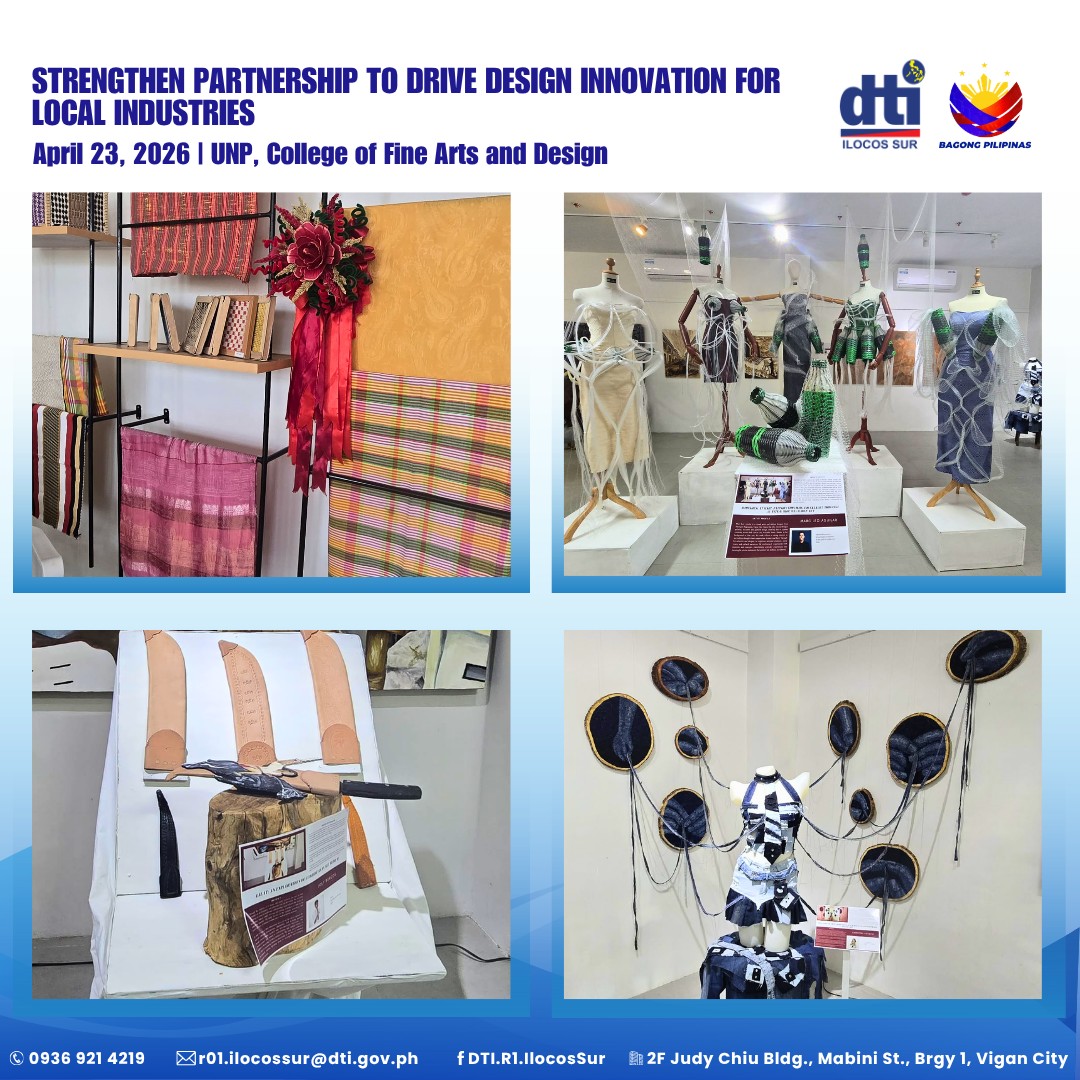
A March 23, 2026 coordinative meeting in Vigan City between DTI Ilocos Sur and UNP's College of Fine Arts and Design formalized a collaboration to deliver design prototypes, product development concepts, and technical assistance to local MSMEs in handloom weaving, handicrafts, and processed products.
 Featured
Amianan Ventures
On March 23, 2026, DTI Ilocos Sur and the University of Northern Philippines College of Fine Arts and Design met in Vigan City to formalize a working partnership that places academic design expertise directly inside the product development pipeline of Ilocos Sur's traditional industries. The collaboration targets three sectors: wearables built around handloom weaving, homestyles encompassing handicrafts and home goods, and processed products. UNP's CFAD faculty will deliver design prototypes, product development concepts, and tailored technical assistance to partner MSMEs.
The partnership solves a structural gap that has constrained Ilocos Sur's traditional industries for decades. The craft is present. The weavers and artisans are present. The missing link has been consistent access to design expertise that can translate cultural heritage into products that compete on modern retail shelves, in export markets, and among younger consumers who appreciate heritage but buy based on contemporary aesthetics.
What UNP's CFAD Brings to This
The UNP College of Fine Arts and Design is the oldest fine arts institution in Northern Luzon, established in 1971 and self-described as the leader of fine arts education in the north, drawing students from as far as Metro Manila, Visayas, and Mindanao. Its programs in Visual Communication, Interior Design, and Fine Arts in Painting produce graduates who have competed and won in local and national design competitions. Faculty members bring both academic depth and practitioner perspective to the partnership.
The outputs UNP CFAD has committed to are specific and deliverable: design prototypes, product development concepts, and technical assistance. These are not advisory opinions. They are design artifacts that MSMEs can take directly to production, test with buyers, and refine based on market feedback. For a handloom weaving enterprise that has been producing the same product line for years, a single strong design prototype can open a new product category without requiring the operator to rebuild from scratch.
Why Abel and Handicrafts Need This Now
Abel Iloko, the traditional handwoven textile of the Ilocos region, is one of the Philippines' most recognized textile heritage products. In Ilocos Sur, production is concentrated in Vigan City, where a small number of families and cooperatives sustain the craft against persistent structural pressures: raw material sourcing from Metro Manila due to insufficient local cotton supply, competition from cheaper machine-produced and imported textiles, aging weaver populations, and design stagnation that limits appeal among younger consumers.
Social enterprises like Abel PH have demonstrated that there is a premium market for Inabel products when they are positioned and designed correctly, with over 150 partner weavers and a growing product line that includes bags, home goods, and apparel. The DTI-UNP collaboration is pursuing the same logic at the provincial level: apply design intelligence to an existing craft tradition to unlock higher market value and broader product reach.
DTI Ilocos Sur's emphasis on integrating "fresh concepts and modern aesthetics" while maintaining cultural heritage identity reflects an approach that the DTI Design Center of the Philippines has been advancing nationally, with the Good Design Award Philippines program recording an 87% increase in entries in 2024 and nine winners earning Japan's globally recognized G Mark. The national design ecosystem is moving. Ilocos Sur is positioning its MSMEs to be part of that movement.
The Industry-Academe Model and Its Limits
Industry-academe design partnerships in the Philippines have historically faced one critical challenge: outputs produced in academic settings often do not complete the journey to commercial adoption. Design prototypes get made, presented, and filed. The DTI-UNP collaboration addresses this directly by including a facilitation mandate, ensuring that selected MSMEs receive support in adopting the designs and translating them into diversified product lines and improved branding, not just receiving the designs as a deliverable.
That facilitation step is where most similar partnerships fail. DTI Ilocos Sur's active role as the commercial connector between UNP's design outputs and MSME operators is the structural element that makes this partnership more likely to produce market results than an academic project alone.
What This Means for Northern Luzon
The DTI-UNP model in Ilocos Sur is directly replicable across Northern Luzon. Cordillera has weaving traditions in Kalinga and Benguet. Ilocos Norte has its own Abel production corridor. Cagayan Valley has handcraft industries in Isabela and Nueva Vizcaya. Every province in the region has traditional craft and food products that carry cultural identity but have not been systematically redesigned for contemporary market access. HEIs with design programs in these provinces, including BSU, UC, and CSU, have faculty with the same capability UNP's CFAD is bringing to Ilocos Sur.
The template is clear: DTI provincial office identifies the MSMEs and the market gap, HEI College of Fine Arts or Design provides the creative and technical inputs, and both institutions share the facilitation responsibility of moving prototype to product. For DTI provincial offices and HEI design programs across Northern Luzon looking for a model to replicate, the March 23, 2026 Vigan City meeting is the starting point to study.
Original Source:
Market Context:
DTI's Design Center of the Philippines recorded an 87% increase in Good Design Award Philippines entries in 2024, with nine winners earning Japan's G Mark, reflecting rapid growth in design-driven MSME development nationally. Abel Iloko production in Ilocos Sur is concentrated in Vigan City, where a small number of families sustain the craft against raw material sourcing challenges, aging weaver populations, and competition from cheaper imported textiles that have suppressed traditional market pricing. Social enterprise Abel PH, working with over 150 partner weavers, demonstrates that premium market positioning for Inabel products is commercially viable when design and branding are applied systematically to the existing craft tradition. UNP's College of Fine Arts and Design, established in 1971, is the oldest and most established fine arts institution in Northern Luzon, with programs in Visual Communication, Interior Design, and Fine Arts in Painting producing graduates who have competed and won in national design competitions.
Are you a founder, innovator, or community builder in Northern Luzon?
We're always looking for compelling stories from the region's ecosystem. Whether you're launching a startup, running a program, or doing something interesting — we'd love to feature you.