
DOST-CAR Installed a VR-Equipped Disaster Preparedness Kiosk at the Mountain Province DRRMO. Here Is What It Does and Why Mountain Province Needs It.
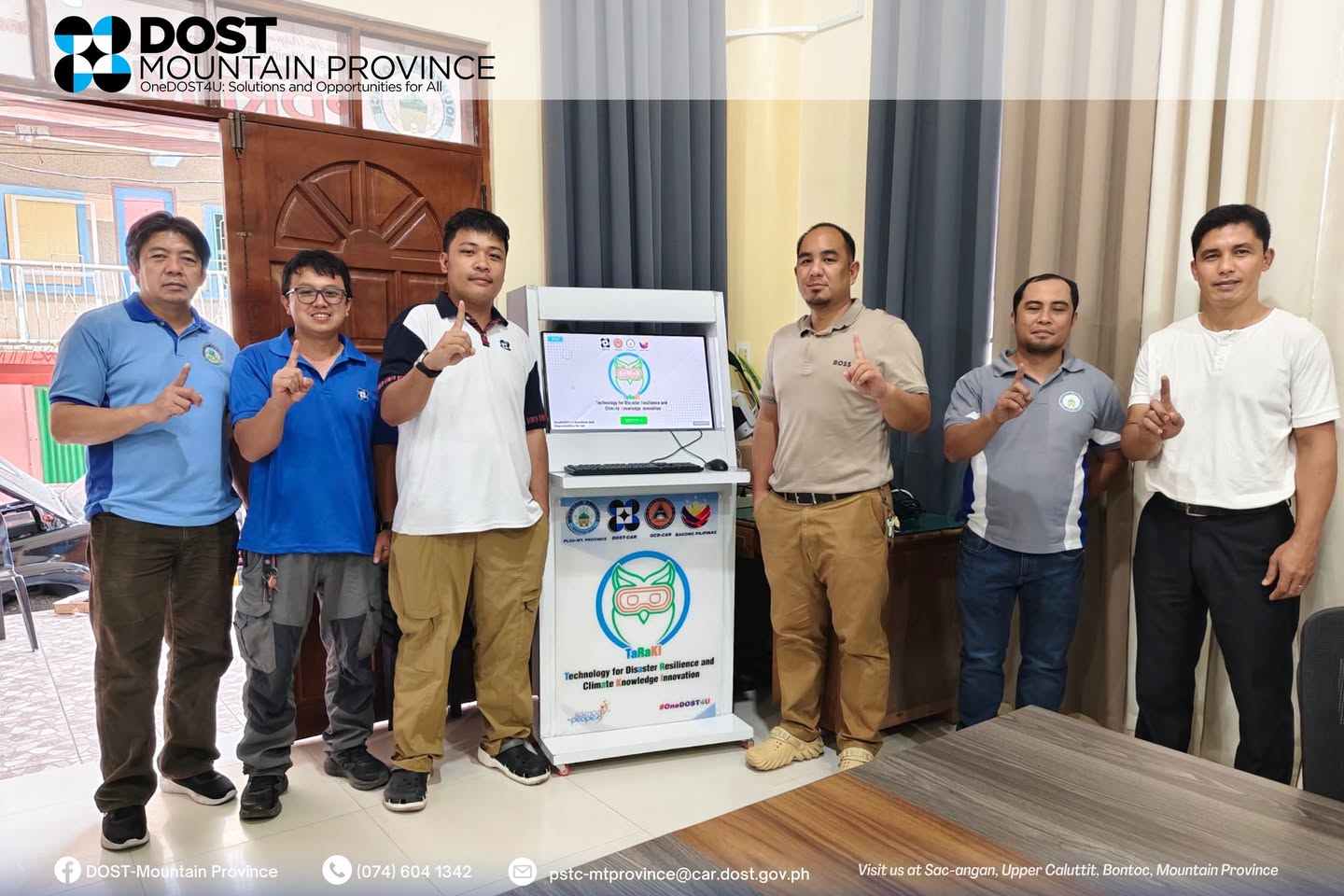
The TARAKI Kiosk, a science-based Knowledge Management System with Virtual Reality, specialized DRR-CCA applications, and curated learning materials from DOST and partner agencies, was formally deployed to the Provincial Disaster Risk Reduction and Management Office of Mountain Province on April 21, 2026.
 Featured
Amianan Ventures
On April 21, 2026, DOST-CAR formally deployed the TARAKI, Technology for Disaster Resilience and Climate Knowledge Innovation, Kiosk to the Provincial Disaster Risk Reduction and Management Office of Mountain Province in Bontoc. The installation was led by Engr. Mark Genesis Laory, SRS II and DRRM Focal Person of DOST-CAR. The kiosk is a Knowledge Management System built around a computer system, specialized DRR-CCA applications, a Virtual Reality component, and a curated library of disaster resilience and climate change adaptation resources drawn from DOST programs, partner agencies, and research initiatives.
Mountain Province is one of the most geographically exposed provinces in the Philippines to landslide events. What happened in Natonin in June 2023, where a landslide struck Barangays Balangao and Banawel, is not an isolated incident. It is the recurring reality of a mountainous province where slope instability, heavy seasonal rainfall, and community settlements in high-risk terrain make disaster preparedness a year-round operational requirement. The TARAKI Kiosk is designed to address the knowledge and preparedness layer of that challenge.
What the TARAKI Kiosk Actually Is
The kiosk is not a brochure rack or a display board. It is an active, technology-enabled knowledge system with four distinct components working together.
The computer system and specialized applications give PDRRMO staff and community members direct access to hazard maps, early warning protocols, evacuation guides, and DRR-CCA learning materials. The VR component is the most operationally distinctive feature: it allows responders and community members to experience simulated disaster scenarios in an immersive environment, building situational awareness and response instinct before an actual event occurs. Training for emergencies through VR simulation is measurably more effective at retention than text-based learning alone, a principle used in military, medical, and emergency management training globally.
The curated resource library integrates materials from multiple DOST programs and partner agencies, ensuring that the kiosk functions as a continuously relevant reference point rather than a one-time installation that goes stale. Baguio City's city council had previously passed Resolution No. 723 in 2024 seeking deployment of the TARAKI Kiosk in the city, indicating demand across the region for this infrastructure.
Mountain Province's Disaster Exposure Profile
Mountain Province is landlocked, mountainous, and sits along multiple fault lines and landslide-prone corridors. The Cordillera mountain range receives among the highest annual rainfall in the Philippines during the typhoon season, and the province's terrain creates concentrated runoff conditions that accelerate slope failure. Bontoc, the provincial capital, sits in a valley surrounded by steep terrain where upland barangays carry persistent landslide risk, as MGB warnings confirmed as recently as October 2025.
The province has invested in early warning systems over time, including PHIVOLCS-installed Deep-Seated Catastrophic Landslide sensors in Tadian and Sagada that transmit real-time slope movement data to the National Institute of Geological Sciences. The TARAKI Kiosk adds the knowledge layer that hardware-based early warning systems cannot provide: the context, learning materials, and response training that PDRRMO staff and community members need to act correctly when those sensors alert.
TARAKI as a Broader Platform
TARAKI in Cordillera is not a single programme. It operates across two distinct mandates under DOST-CAR. The disaster resilience kiosk deployed to Mountain Province is the DRR-CCA track. Separately, the Technological Consortium for Awareness, Readiness and Advancement of Knowledge in Innovation, also called TARAKI, is a startup and technology business incubation programme that has supported approximately 20 startups in Baguio and Benguet since 2021, including three enterprises gaining national market recognition. Both tracks share a name and the DOST-CAR umbrella, but serve distinct purposes: one builds community resilience, the other builds economic resilience through innovation.
The Mountain Province PDRRMO deployment is the DRR-CCA track in action, continuing a regional rollout that has been building across Cordillera's six provinces and Baguio City.
What This Means for Northern Luzon
Mountain Province's TARAKI Kiosk deployment is a template for how science agencies can add practical value to the last mile of disaster preparedness infrastructure in remote highland provinces. The gap in most Philippine province DRRMO offices is not political will or budget alone. It is access to organized, science-based, actionable knowledge in a format that PDRRMO staff and community responders can actually use without specialist training. The kiosk closes that gap in a single installation.
For Abra, Kalinga, Apayao, Ifugao, and other Northern Luzon provinces with high landslide, flooding, and seismic exposure, the question to ask DOST-CAR is direct: when is the TARAKI Kiosk coming to our PDRRMO? The regional rollout is active. The infrastructure is proven. The deployment timeline is the priority to push.
Original Source:
Market Context:
Mountain Province recorded a major landslide event in Natonin in June 2023, affecting Barangays Balangao and Banawel, and the Mines and Geosciences Bureau issued landslide warnings for Bontoc upland barangays as recently as October 2025, underscoring the province's persistent high-risk exposure. The Philippines ranks among the top ten most disaster-prone countries in the world, with Cordillera's mountainous terrain among the country's highest-risk landslide zones due to its combination of steep slopes, high annual rainfall, seismic activity, and dense upland community settlements. Baguio City's city council passed Resolution No. 723 in 2024 seeking TARAKI Kiosk deployment, indicating active demand from LGUs across the region for this DOST-CAR disaster preparedness infrastructure. DOST-CAR's TARAKI startup programme, operating separately from the disaster resilience kiosk under the same name, has supported approximately 20 startups in Baguio and Benguet since 2021, with at least three enterprises gaining national market recognition.
Are you a founder, innovator, or community builder in Northern Luzon?
We're always looking for compelling stories from the region's ecosystem. Whether you're launching a startup, running a program, or doing something interesting — we'd love to feature you.