
DICT-CAR Turns 10: Over 40,000 Trained, 282,802 eGov App Users, and a Five-Week Celebration Bringing Digital Services to Every Corner of the Cordillera
The Department of Information and Communications Technology Cordillera Administrative Region marked its 10th anniversary with a Kapihan media session on June 5, 2026, announcing new digital platforms, expanding e-governance coverage to 52 of 77 LGUs, and launching a month-long program that includes mobile digital hubs for communities with no connectivity.
 Featured Partner
Inv8 Studio
Innovation Partner for Startups & Growing Businesses
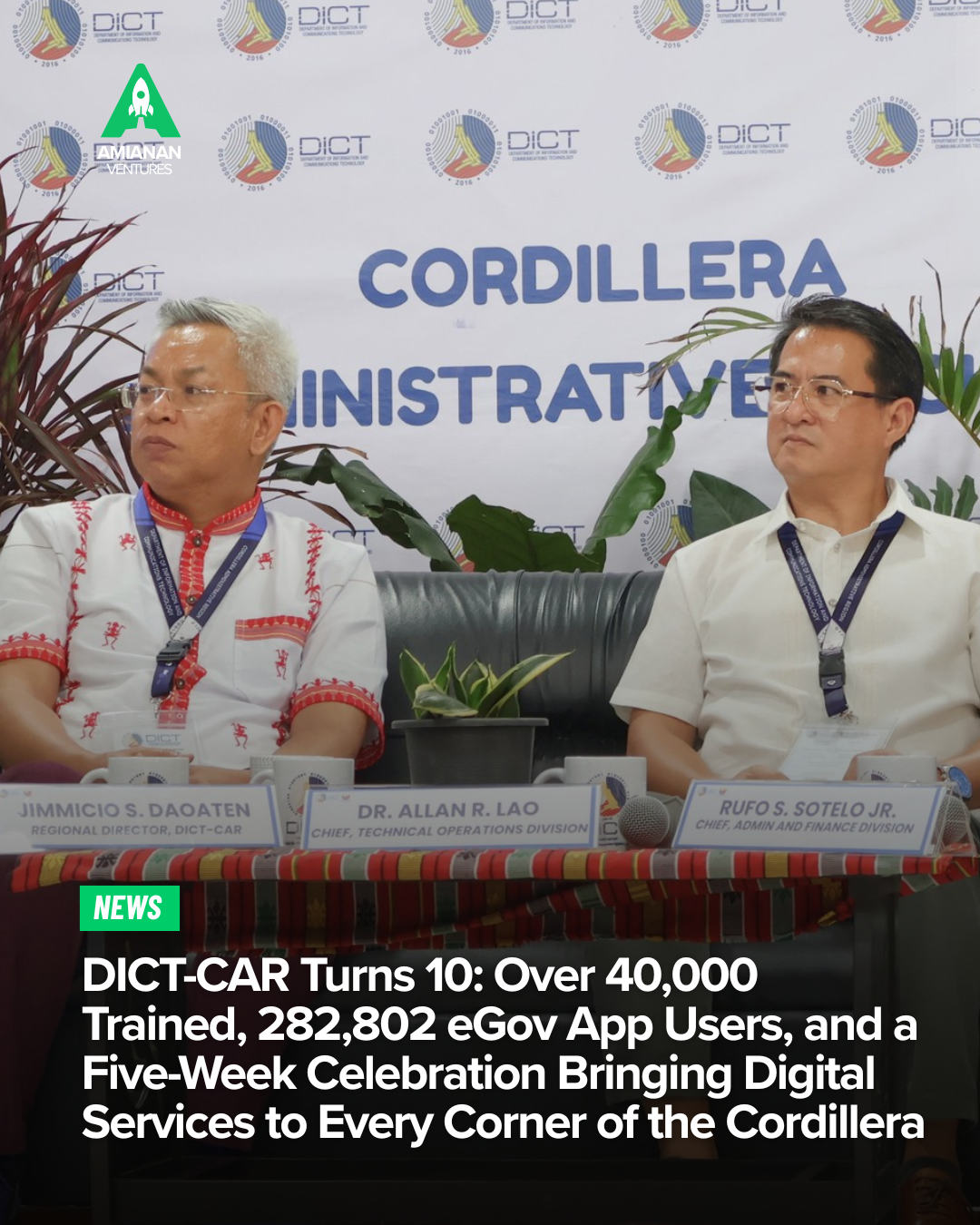
The Department of Information and Communications Technology Cordillera Administrative Region held a Kapihan media session on June 5, 2026, anchored on the theme "Isang Dekadang Digital: Konektado sa Puso at Serbisyo," as the department marks ten years since the DICT was established through Republic Act No. 10844 in 2016. The session, led by Regional Director Jimmicio S. Daoaten and Chief of Technical Operations Division Dr. Allan R. Lao, surfaced a decade of measurable progress across digital training, e-governance, cybersecurity, and last-mile connectivity in one of the country's most geographically complex regions.
Ten years of digital work in the Cordillera is worth reading carefully. The numbers are real, the challenges are honest, and the next twelve months are more ambitious than anything the department has done before.
A Decade by the Numbers
More than 40,000 individuals across the Cordillera have been trained on information and communications technology through DICT-CAR programs delivered via online and face-to-face modalities since 2016. That training base spans students, government workers, community members, and MSMEs across Abra, Apayao, Benguet, Ifugao, Kalinga, Mountain Province, and Baguio City.
The eGov PH App has recorded 282,802 users in the Cordillera region as of February 28, 2026, a figure that reflects genuine public adoption of a digital government platform in a region where many communities still face intermittent connectivity. The Philippine National Public Key Infrastructure, or PNPKI, now has 7,641 active users in the region, authenticating electronic documents, protecting information from unauthorized alterations, and securing online transactions for government processes that previously required physical presence and paper-based verification.
On the local government side, 52 of the 77 LGUs in the Cordillera Administrative Region have been onboarded to the eLGU platform, with 47 already fully operational. The platform digitizes the processing of business permits, civil registry records, building permits, and other frontline government services, reducing manual transactions and improving the speed and transparency of public service delivery at the municipal and city level.

What Comes Next: The Learning Experience Platform
DICT-CAR is preparing to launch the Learning Experience Platform, or LXP, a certification-based digital training system targeting students, freelancers, and MSMEs in the digital economy. The LXP is the department's clearest signal yet that its training mandate is shifting from reach to credential, moving beyond participant counts and into building verifiable digital skills that are recognized in the labor market and the freelance economy.
For the Cordillera's growing population of young professionals and students exploring digital work opportunities, the LXP represents a direct pathway into the national and global digital economy without leaving the region. For MSMEs navigating the transition to digital tools and online markets, it is structured capacity building from the government agency that is closest to their operating environment.
Five Weeks, Five Fronts
DICT-CAR's anniversary celebration runs for five weeks through June 2026, with each week targeting a distinct dimension of digital inclusion:
Week 1: Konektado Tayo Kapehan. Media and academe dialogues on DICT programs, regional initiatives, and digital education, including the Kapihan session that anchored this report.
Week 2: Cyber Bayanihan. Cyber hygiene awareness programs, the official DICT 10th Anniversary on June 9, 2026, a DICT-CAR Open House, simultaneous SIM card distributions in Benguet, and digital literacy training for senior citizens and barangay leaders.
Week 3: Digital Workforce Week. AI readiness programs, freelancing skills training, and growth toolkits for MSMEs.
Week 4: Walang Iwanan Caravan. Mobile digital hubs deployed to bring government services and the eGov Super App directly to areas with limited or no connectivity.
Week 5: Bayani sa Last Mile Awards. The culminating ceremony honoring individuals and organizations that have championed digital inclusion and supported digital transformation in underserved communities.
The structure of the five-week program is deliberate. It addresses infrastructure, skills, services, and recognition in sequence, treating digital inclusion not as a single intervention but as a sustained campaign across multiple dimensions of access.
"Awan ti Maibati a Cordilleran"
Regional Director Daoaten's framing of the DICT's anniversary is worth quoting directly. "The DICT is what we call 'sinaunang bago' (ancient yet new)," he said. "While the Department itself is relatively young, our roots trace back decades, from the early telegraph and communication systems of the 1900s to the establishment of the DICT in 2016. This 10th anniversary is a reminder that digital transformation is not just about technology. It is about people. Konektado sa puso at serbisyo. It is about deepening public service so that no Filipino, and no Cordilleran, is left behind."
That last phrase, "Awan ti maibati a Cordilleran" in Ilocano, is not a slogan. It is an operating standard for a region where Geographically Isolated and Disadvantaged Areas are not edge cases but structural features of the landscape. The Cordillera's terrain means that digital inclusion requires active outreach, not just platform availability. The Walang Iwanan Caravan in Week 4 is the most direct expression of that commitment: physically bringing government services into communities that cannot reliably access them from a fixed office or a stable internet connection.
What This Means for the Cordillera's Founders and Communities
For founders, developers, and MSMEs in the Cordillera, the DICT-CAR anniversary programme is not just a government celebration. It is a calendar of concrete opportunities. The Digital Workforce Week in Week 3 offers AI readiness and freelancing skills training that is directly applicable to anyone building a digital business or a freelance career from the region. The LXP launch will open structured certification pathways. The eLGU expansion means that business permits and government transactions for 47 operational LGUs are now processable without manual queuing.
The 40,000 people trained over ten years is a foundation. The next ten years, with the LXP, the eGov app at 282,802 users and still growing, and mobile digital hubs reaching communities that have never had consistent government service access, is where that foundation gets built upon.
Digital transformation in the Cordillera is not happening despite the terrain. It is happening through it, one barangay, one LGU, and one trained Cordilleran at a time.
Original Source
This article is based on reports from the DICT-CAR Kapihan media session, "Connecting Peaks and People: A Decade of Digital Service, Progress, and Opportunity in the Cordilleras," published by DICT-CAR on June 5, 2026. We are grateful for the original reporting that brought this story to light. Provincial offices across Abra, Apayao, Benguet, Ifugao, Kalinga, Mountain Province, and Baguio City contributed to the regional programme.
Market Context
The Philippines' digital economy is projected to reach USD 35 billion by 2030, with government digitization identified as a primary driver of that growth. The country's e-government initiatives, including the eGov PH App and eLGU platform, are among the most direct tools for reducing the cost and friction of public service delivery in geographically dispersed regions like the Cordillera. The global digital skills gap remains a structural challenge for developing economies, with demand for certified digital workers outpacing supply across Southeast Asia. For the Cordillera, where geography has historically limited physical access to training and government services, platforms like the LXP and mobile digital hubs represent high-leverage investments in the region's long-term economic participation in the digital economy.
Are you a founder, innovator, or community builder in Northern Luzon?
We're always looking for compelling stories from the region's ecosystem. Whether you're launching a startup, running a program, or doing something interesting — we'd love to feature you.