
Cabagan, Isabela Just Got a FabLab. The Municipality That Ranks 43rd Nationally in Innovation Just Gave Its MSMEs Access to Digital Fabrication Technology.
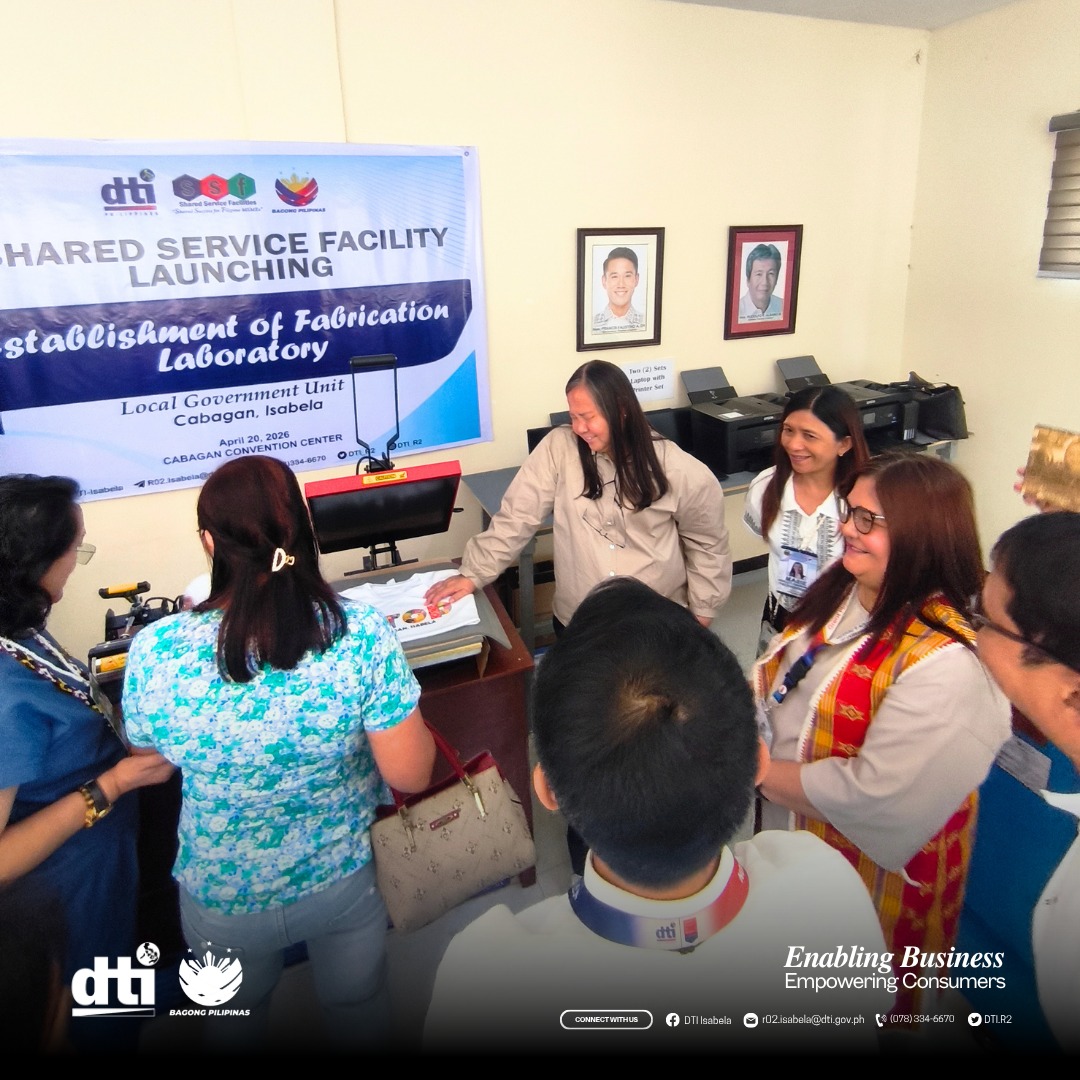
DTI Isabela and the LGU of Cabagan launched the SSF Fabrication Laboratory on April 20, 2026, giving local MSMEs, students, and innovators access to modern digital fabrication equipment for product design, prototyping, and development — the second DTI-SSF investment in Cabagan in 14 months.
 Featured Partner
Inv8 Studio
Innovation Partner for Startups & Growing Businesses
On April 20, 2026, DTI Isabela Provincial Office and the Local Government Unit of Cabagan formally launched the Shared Service Facility Fabrication Laboratory, a FabLab, at a ceremony attended by Mayor Mila A. Mamauag, LGU officials, and partner institutions. DTI Region 2 Regional Director Ma. Sofia G. Narag committed DTI's ongoing role beyond delivery, including active monitoring and ensuring the facility is properly utilized by its intended beneficiaries. The launch is the second DTI-SSF investment in Cabagan in 14 months, following a PHP 540,000 meat processing SSF delivered to the Cabagan Meat Vendors and Butchers Association in February 2025.
Cabagan is a first-class municipality in Isabela with a population of 56,468 and a land area of 430 square kilometers. It ranks 43rd nationally in Innovation among Philippine municipalities, scoring in the top tier for ICT planning, e-BPLS software adoption, online payment facilities, and internet capability. The FabLab is the infrastructure investment that matches the innovation ambition those rankings suggest.
What a FabLab Is and What Cabagan's Offers
A Fabrication Laboratory is a digital manufacturing space equipped with tools that translate designs into physical prototypes and products. Standard DTI SSF FabLabs in the Philippines are equipped with 3D printers, CNC milling machines, laser cutters, and vinyl cutters, the core suite that allows an MSME owner, a student, or a community innovator to take an idea from sketch to testable object without factory-scale capital investment.
The concept originated at MIT and has been deployed in over 65 countries as a tool for economic development, entrepreneurship, and skills building. In the Philippine context, DTI has been rolling out FabLabs as SSFs since 2013, with facilities now operating in Ilocos Sur, Saint Louis University Baguio, Bataan State University, Cavite, Caraga, and a growing number of provincial hubs. Cabagan's FabLab joins that national network, giving the municipality's producers and innovators access to the same digital fabrication ecosystem available in more urbanized provincial centers.
Acting Provincial Director Atty. Cyrus I. Restauro emphasized the defining characteristic of the SSF model: the facility is shared, meaning it serves multiple MSMEs, students, and innovators within a single installation, distributing the cost of technology access across a community rather than requiring any individual operator to own the equipment outright. That shared structure is what makes a FabLab viable for a municipality like Cabagan, where individual MSMEs could not sustain a 3D printer or CNC machine on their own but can access one collectively.

Why Cabagan Is the Right Location
Cabagan's DTI CMCI profile reveals a municipality that punches above its weight on innovation metrics while carrying room to grow on economic dynamism indicators. Ranked 43rd nationally in Innovation and 1st in ICT planning and e-government infrastructure, Cabagan has already built the digital governance foundation that an innovation facility like a FabLab requires: reliable internet connectivity, a digital-ready LGU, and institutional commitment to technology adoption.
Mayor Mila A. Mamauag's message at the launch was explicit about the nature of that commitment: the FabLab reflects not only her administration's priorities but those of the entire LGU including barangay captains, signaling bottom-up buy-in rather than a top-down programme delivery that communities tolerate without using. That distinction matters for facility utilization. FabLabs in the Philippines that have underperformed their potential have typically done so because the LGU partnership was transactional rather than ownership-based. Cabagan's framing is the right one.
The SSF Pattern in Isabela
The Cabagan FabLab is part of a broader DTI SSF deployment pattern across Isabela Province in 2025 and 2026. In February 2025, Cabagan received a meat processing SSF for the local butchers association. Isabela's position as Region 2's most economically productive province, responsible for approximately 30% of the Philippines' rice supply and with growing agribusiness, manufacturing, and logistics sectors, makes it a natural priority for DTI SSF investment. The FabLab extends that investment logic from food processing into manufacturing innovation and digital fabrication, broadening the MSME development support to include product design and prototyping capacity that food processing facilities cannot provide.
Director Narag's commitment to ongoing monitoring rather than one-time delivery is the programmatic element that distinguishes sustainable SSF deployments from white-elephant facilities. DTI's track record with FabLabs at Bataan State University and other host institutions shows that co-location with an academic institution or a deeply committed LGU consistently produces better utilization outcomes than standalone community deployments.
What This Means for Northern Luzon
A FabLab in Cabagan means that an MSME owner in Isabela who wants to redesign a product, prototype a packaging solution, or fabricate a custom component no longer needs to travel to Baguio City's Saint Louis University FabLab or to Manila to access digital fabrication equipment. For a municipality that already ranks among the top tier nationally in innovation infrastructure, the FabLab closes the physical fabrication gap that has separated Cabagan's innovation ambition from its manufacturing capability.
For DTI SSF programme coordinators and LGUs across Cagayan Valley and Northern Luzon looking at replication: Cabagan's model is a documented case study in progressive SSF investment, beginning with food processing, adding digital fabrication, and using a single engaged LGU as the anchor for multiple facility types over consecutive budget cycles. It is the right sequence, and it is producing results.
Original Source:
Market Context:
DTI's SSF FabLab programme has operated since 2013, with facilities now in Ilocos Sur, Baguio City, Bataan, Cavite, Caraga, and growing provincial coverage, providing MSMEs with 3D printing, CNC milling, laser cutting, and vinyl cutting services under a shared access model. Cabagan ranks 43rd nationally in Innovation among Philippine municipalities, scoring 1st in ICT planning, e-BPLS software, and online payment facilities, making it one of the most digitally prepared municipalities in Cagayan Valley for absorbing advanced fabrication technology. DTI Region 2 delivered a PHP 540,000 meat processing SSF to Cabagan's butchers and meat vendors association in February 2025, establishing the LGU-DTI partnership that made the April 2026 FabLab launch the second consecutive SSF investment in the municipality. The FabLab concept, originating at MIT, is now deployed in over 65 countries as a tool for SME development, youth employment, and sustainable community production, with evidence from developing country deployments showing significant positive impact on entrepreneurship and product innovation when government funding and skills training are provided alongside equipment access.
Are you a founder, innovator, or community builder in Northern Luzon?
We're always looking for compelling stories from the region's ecosystem. Whether you're launching a startup, running a program, or doing something interesting — we'd love to feature you.