
How to Start a Startup as a Student
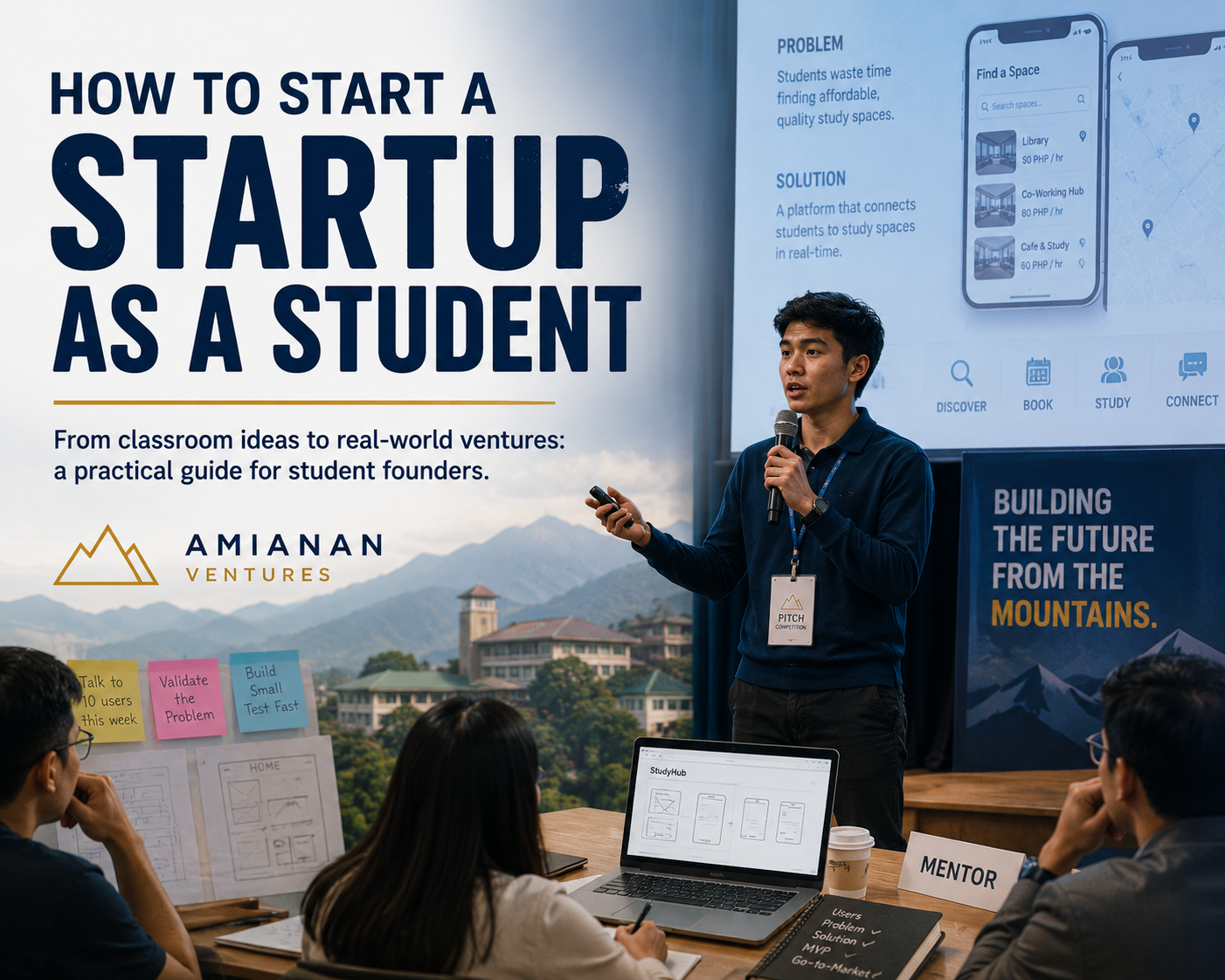
I joined my first startup competition as a college student with no prototype, no revenue, and no real idea of what I was doing. What I had was a problem I cared about, a rough pitch, and enough nerve to submit an application. That decision shaped how I think about building startups far more than any classroom did. This is what I learned and what I wish someone had told me before I started.

Leandro Gepila
Founder / Co-founderInv8 Studio · cordillera
Product & Innovation Operator based in Baguio. I work with founders, institutions, and teams to turn ideas into validated products and build structured innovation programs that drive real outcomes.
 Featured
Amianan Ventures
I joined my first startup competition as a college student with no prototype, no revenue, and no real idea of what I was doing. What I had was a problem I cared about, a rough pitch, and enough nerve to submit an application. We were nervous standing in front of the panel. But we showed up.
That decision to show up, not just once but repeatedly, across competitions like the Philippine Startup Challenge and PLDT SMART Innovation Generation, shaped how I think about building startups far more than any classroom did. This article is a distillation of what I learned and what I wish someone had told me before I started.
You Have More Advantages Than You Think
The common assumption is that students are disadvantaged as founders: no money, no business experience, no established network, and a full academic workload competing for your time. This is partly true. But it misses something important.
As a student, you are surrounded by potential users, collaborators, and mentors inside a single institution. Your classmates are your first focus group and your first testers. Your professors have industry connections and domain expertise you can access through a conversation after class. Your university likely has a technology business incubator or entrepreneurship center offering free coaching, co-working space, and connections to national programs.
You are also embedded in the community you are building for. A student at Benguet State University who grew up in a farming household understands agricultural supply chain friction in ways that no market research report can replicate. That proximity is the beginning of a real competitive advantage.
Action Step: Map your university's startup support resources before you do anything else. Look for a TBI, an entrepreneurship office, a research center, or an innovation fund. Talk to the person who runs it. Many of these programs have free mentoring, grants, and incubation slots available to any registered student who applies. Most students never ask.
Join Competitions. But Know Why You Are Joining.
When I was a student, I joined startup competition after startup competition. The Philippine Startup Challenge. PLDT SMART Innovation Generation. Several local and regional ones I could get to. At the time, we were not building prototypes. We were presenting ideas and testing ourselves against the experience of actually pitching.
We were nervous every time. We won some rounds and lost more. But the single most valuable thing that came from those competitions was not the trophies or the certificates. It was the connections. Every competition put us in the same room with industry practitioners, experienced mentors, investors, and fellow founders who were thinking about problems the same way we were. The feedback we received from judges in a single afternoon gave us more grounded, practical insight than entire semesters of coursework had.
That is what competitions are actually for at the student stage: exposure, connections, and the kind of industry-facing feedback that school rarely provides on its own. If you treat them as that, they are enormously valuable.
A note of caution: I am not encouraging every founder to join every competition they can find. There is a real risk in overdoing it. When you are jumping from pitch to pitch, your idea gets pulled in multiple directions by different panels of judges with different opinions, your focus fragments, and you start optimizing for presentation rather than for the actual work of building and testing. Worse, you can start to feel like you are making progress because you are winning competitions, when in reality your startup is not moving at all. Winning a pitch competition is not traction. It is practice. Keep that distinction clear.
Join competitions deliberately. Pick the ones that connect you to the specific mentors, networks, or ecosystems most relevant to what you are building. Treat each one as a structured learning event, not as a measure of your startup's health.
Action Step: Before you register for any competition, write down one specific thing you want to learn or one specific connection you want to make from it. If you cannot answer that clearly, skip that competition and focus on talking to real customers instead.
Your Student Status Is a Door Opener. Use It Before It Closes.
One thing I did not fully appreciate when I was starting out: people are remarkably willing to help students. Not because students are special, but because there is no threat. When a student reaches out to a business owner, a government official, or an industry practitioner and says they are researching a problem for a school project or an early-stage idea, most people say yes to a conversation. That same person will screen their calls and decline meetings from someone who appears to be selling something.
This window is temporary. Once you graduate and start presenting yourself as a professional founder, the dynamic shifts. You are no longer a student asking for learning. You are a competitor, a vendor, or an unknown quantity. Some doors close. Use the ones that are open now.
This means being deliberate about who you reach out to while you still have the student label working for you. Reach out to the founders whose companies you admire. Ask the municipal agriculture officer if you can sit in on a barangay extension visit. Request a 20-minute conversation with the head of a TBI you are considering applying to. Email the professor whose research is directly related to the problem you are working on. Most of them will say yes because you are a student and the ask is small.
Every one of those conversations is an asset you are building before you even have a product.
Action Step: Make a list of five people outside your university who have direct knowledge of the problem you are working on. Send each of them a brief, honest message: who you are, what you are working on, and what you want to learn from them. Do not pitch. Just ask for 20 minutes. You will be surprised how often people say yes.
Find Your Co-Founder Before You Graduate
Most founder content talks about co-founders in the abstract. Find someone who complements your skills. Find someone you trust. Find someone with high commitment.
What that advice misses is that university is one of the best possible environments to find a co-founder, and most students do not use it intentionally. You are surrounded by people across different disciplines who are working on problems alongside you, under shared conditions, with observable work habits and character. You can see how someone handles pressure during exam season. You can see whether they follow through on what they commit to in a group project. You can work on small things together and see whether the collaboration actually functions before you commit to something bigger.
A business student who spots market opportunities and a computer science student who can build things is a classic pairing. An agriculture student who understands the farming supply chain and an engineering student who can design better equipment is a regional one that matters here. A nursing student who knows the gaps in rural health service delivery and a communications student who can explain things simply is another.
You do not need to have a finished idea before you start building a relationship with a potential co-founder. Find someone in your institution whose thinking you respect, whose skills are different from yours, and whose commitment you can observe directly. Work on something small together first. The co-founder conversation follows naturally from that.
Action Step: Identify one person in your institution whose skills complement yours and whose work ethic you have directly observed. Start a conversation about the problem you are working on. Not a pitch. Just a conversation. See where it goes.
The Family Pressure Problem
This section does not appear in most startup guides because most startup guides are not written for Filipino students.
In the Philippines, the decision to spend significant time on a startup idea while you are supposed to be studying is rarely a private one. Parents have invested in your education, often at real sacrifice. Extended family has expectations tied to your degree. The cultural weight of finishing your course and getting a stable job is real, and it does not disappear just because you are excited about a business idea.
I am not going to tell you to ignore your family or that the pursuit of your startup should override everything else. That framing is irresponsible. What I will say is that the tension between startup work and family expectations is manageable if you are honest and intentional about it.
The founders I have seen handle this well do a few things consistently. They do not hide what they are working on. They bring family members into the story early, in plain terms, without the startup jargon that makes it sound riskier than it is. They protect their academic standing so that the startup work never becomes a legitimate source of concern. And they set a personal threshold: if grades drop below a certain point, startup work pauses. That boundary, stated clearly and kept, builds the trust that gives you room to keep going.
The founders who struggle are the ones who pursue their startup covertly, let their grades slip, and then face a family confrontation that forces a binary choice they were not ready for.
Your family's concern is not an obstacle. It is information about the expectations you are operating within. Work with it rather than around it.
TBIs and Student Programs Are Underused
Technology Business Incubators are among the most underused resources available to student founders in the Philippines. DOST and DTI both support a national network of TBIs housed inside universities, and many of them have programs specifically designed for student and youth entrepreneurs.
What TBIs offer is not just space. They provide structured mentorship from practitioners who have built and operated businesses. They connect you to national programs including DOST's SETUP and NEGI grants. They give your startup institutional legitimacy that makes it easier to open conversations with potential partners and customers. And for a student with no capital, they remove the cost barrier entirely: incubation slots are free.
In Baguio and the broader Cordillera, the active TBIs include University of the Philippines SILBI, Saint Louis University TBI , UC Innovation and Technology Transfer Office, Kalinga State University TBI, Benguet State University TBI and the DOST-CAR iHub. These institutions exist to support founders at exactly the stage you are at right now. Use them.
Beyond TBIs, look at the broader program landscape. Republic Act 10679, the Youth Entrepreneurship Act, creates a mandate for government agencies to support youth-led enterprises. The DTI OTOP Youth Entrepreneurship Program, the National Youth Commission's entrepreneurship initiatives, and CHED's higher education innovation programs all have tracks for student founders. The opportunities are not widely publicized, but they are real, and most of them require nothing more than a student ID and a problem worth solving.
Action Step: Visit the TBI or entrepreneurship office at your university this week. If your university does not have one, go to the nearest DOST-CAR or DTI-CAR office and ask what programs are open to student entrepreneurs. Bring a one-paragraph description of the problem you are working on. You do not need a finished product to start the conversation.
Align Your Academic Work With Your Startup
One of the most effective things I did as a student founder was find ways to make my academic requirements serve my startup work at the same time. A research methods course becomes the vehicle for 30 structured customer interviews. A marketing class project becomes the first version of a go-to-market plan. A capstone thesis becomes early product research with institutional backing.
This alignment is not always possible and it is not always the right call. Some professors will have a clear opinion that academic work and startup projects should stay separate, and that boundary is worth respecting. Academic rigor and startup experimentation operate on different timelines and with different success criteria. When your professor tells you to keep them separate, listen. There is often a good reason for it.
But when alignment is possible, pursue it. The academic calendar imposes structure and deadlines that can accelerate startup work rather than slow it down. The requirement to produce something documented and defensible forces the kind of clear thinking that founders often avoid when they are moving fast.
One practical note: If you are going to align a class project with your startup work, be transparent with your professor about it upfront. Explain what you are working on and why the project is relevant. Most professors respond well to students who are thinking practically about the connection between coursework and the real world. The ones who object are usually pointing at a real tension worth taking seriously.
Where the Region Stands
Filipino students launched more than 300 new ventures through university-based technology business incubators in 2024, according to data from the Department of Science and Technology. The national ecosystem has programs, funding, and institutional infrastructure that simply did not exist a decade ago.
In Northern Luzon, the ecosystem is younger but it is growing. DOST-CAR's iHub, the regions TBI's are actively supporting early-stage founders. The regional problems in agriculture, tourism, indigenous trade, logistics, and local governance are significant, specific, and largely unaddressed by products built in Metro Manila. The founder who builds deep knowledge of one of these problems from the inside of this region has an advantage that cannot be imported.
The First Three Steps
If you are a student with an idea and do not know where to start, here is the sequence I would follow:
Talk to 10 people who you believe have the problem you want to solve. Do not pitch your solution. Ask about their experience. Listen more than you talk.
Visit the TBI, entrepreneurship office, or innovation center at your university. Introduce yourself. Ask what is available to student founders. Apply for whatever is relevant.
Write a one-paragraph problem statement: who has the problem, what the problem is, and why current solutions fall short. Share it with someone whose judgment you trust and ask for honest feedback.
You do not need a finished product to start. You do not need to win a pitch competition to validate your idea. You need a problem worth solving and the willingness to test your assumptions in the real world before you commit to building.
I started from this region, with limited resources and no playbook. The ecosystem that exists here now is better than what I had. Use it.
Comments
Leave a Comment
Community Contributions
Have a story to share?
Founders, researchers, and builders — submit your perspective.