
Why Innovation and Entrepreneurship Are Not the Same Thing
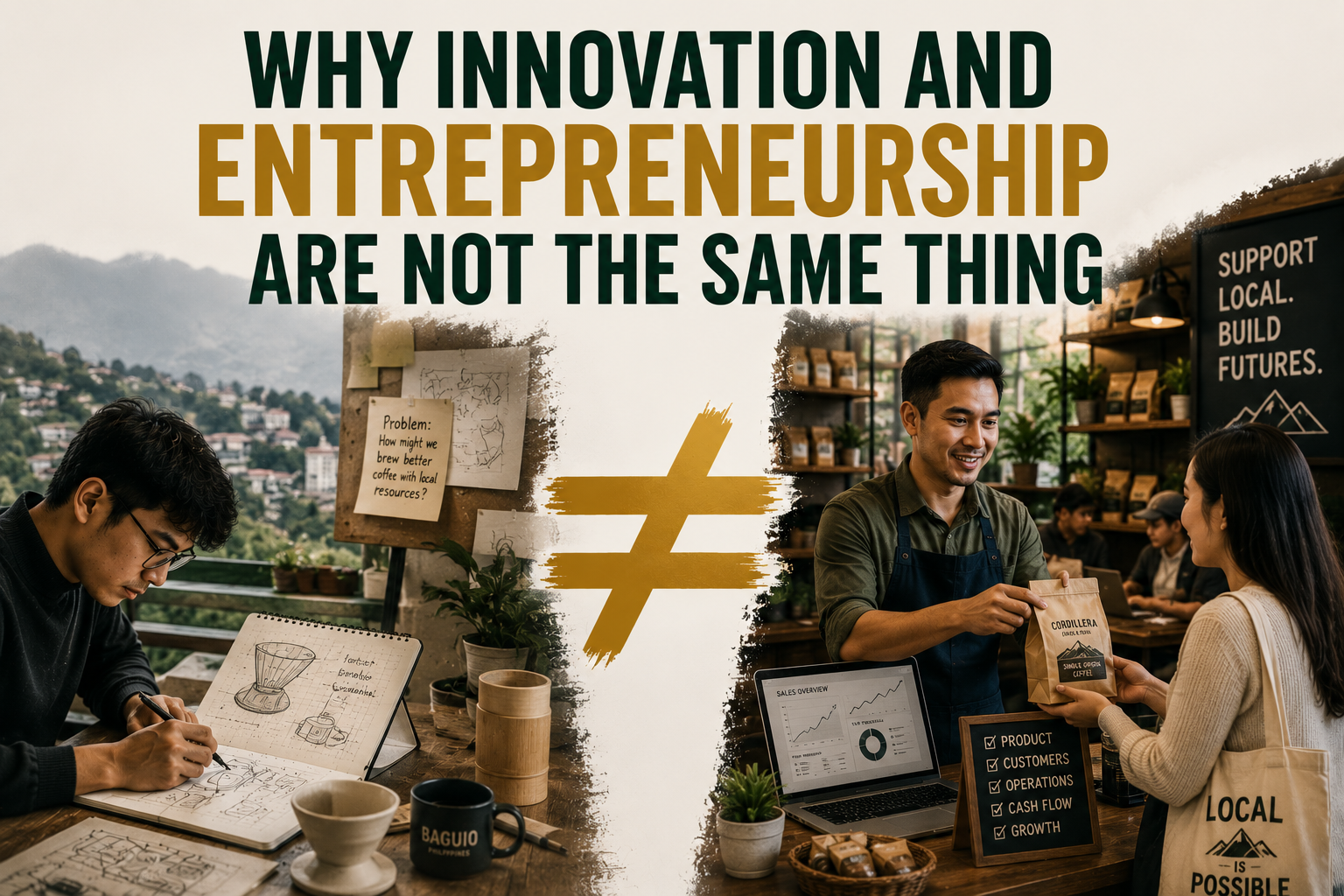
Most startup ecosystems treat innovation and entrepreneurship as the same thing. They are not. Innovation creates new value. Entrepreneurship captures and scales it. This piece breaks down the distinction with real examples and applies it directly to founders, MSMEs, and ecosystem builders in Northern Luzon. You do not need to invent something unprecedented to start building.

Leandro Gepila
Founder / Co-founderInv8 Studio · cordillera
Product & Innovation Operator based in Baguio. I work with founders, institutions, and teams to turn ideas into validated products and build structured innovation programs that drive real outcomes.
 Featured
Amianan Ventures
The Distinction That Changes How You Build
When people talk about startups, innovation and entrepreneurship are often used interchangeably. A founder with a new idea is called an innovator. An innovator launching a company is called an entrepreneur. In everyday conversation, the distinction rarely matters.
But for anyone building businesses, supporting founders, or strengthening local startup ecosystems, understanding the difference is not an academic exercise. It is a practical one. Many promising ideas fail because they never become businesses. Many successful businesses thrive without inventing anything entirely new. Innovation and entrepreneurship are deeply connected, but they are not the same thing.
The Definitions That Matter
Innovation is the creation of something new or significantly improved that generates value. This could be a product, a service, a process, a technology, a business model, or even a new way of solving an existing problem.
Entrepreneurship is the process of identifying opportunities and organizing resources to create, grow, and sustain a venture.
Put simply:
Innovation creates new value. Entrepreneurship turns that value into economic and social impact.
An innovator focuses on solving problems differently. An entrepreneur focuses on building an organization capable of delivering that solution to customers consistently and sustainably. While one can exist without the other, the most impactful ventures combine both.
Innovation Creates Value. Entrepreneurship Captures It.
This is one of the clearest ways to understand the relationship between the two concepts.
Imagine someone develops a new water purification technology that provides clean drinking water at a fraction of current costs. The invention itself is innovation. It creates value because it solves a real problem in a better way. But unless someone manufactures the product, builds distribution channels, reaches customers, secures funding, and creates a sustainable business around it, the innovation never creates widespread impact. That process is entrepreneurship.
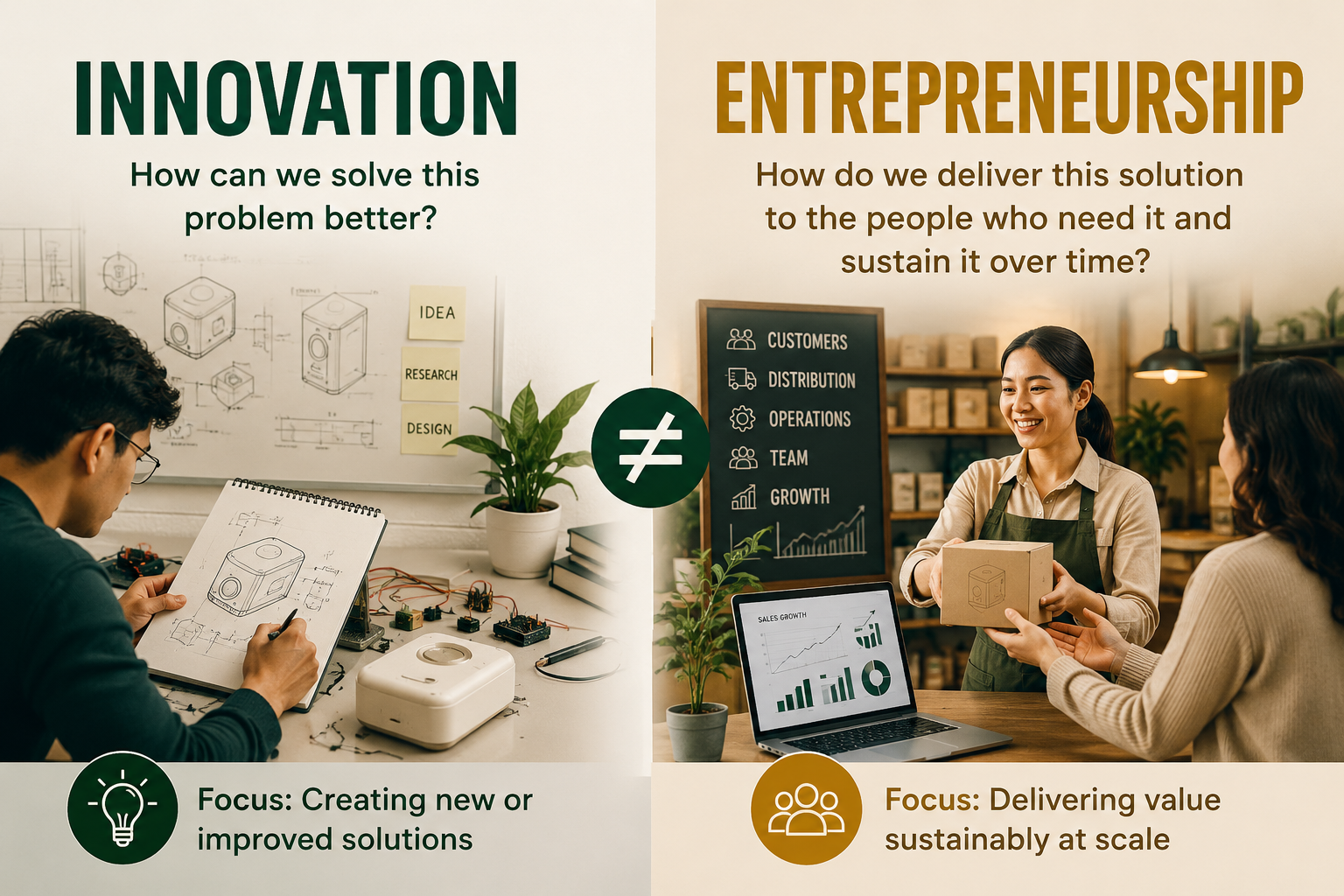
Without innovation, businesses risk becoming commodities competing on price alone. Without entrepreneurship, innovations often remain ideas, prototypes, or research projects that never reach the people who need them.
What Daniel Isenberg's Work Tells Us
Entrepreneurship scholar and ecosystem strategist Daniel Isenberg has long argued that entrepreneurship should not be confused with innovation. In many developing ecosystems, policymakers and support organizations focus heavily on innovation, assuming that more ideas automatically lead to more successful businesses. Isenberg challenges this assumption directly.
His work emphasizes that entrepreneurship is fundamentally about creating and growing ventures that generate value in the marketplace. While innovation can strengthen entrepreneurship, it is not always a prerequisite. A business can succeed by executing better, serving customers more effectively, improving access, or adapting proven models to underserved markets.
This insight is particularly relevant in emerging ecosystems where founders often feel pressured to create groundbreaking technologies when meaningful business opportunities may already exist in solving everyday problems better than anyone else currently does.
Three Examples That Clarify the Difference
Innovation Without Entrepreneurship
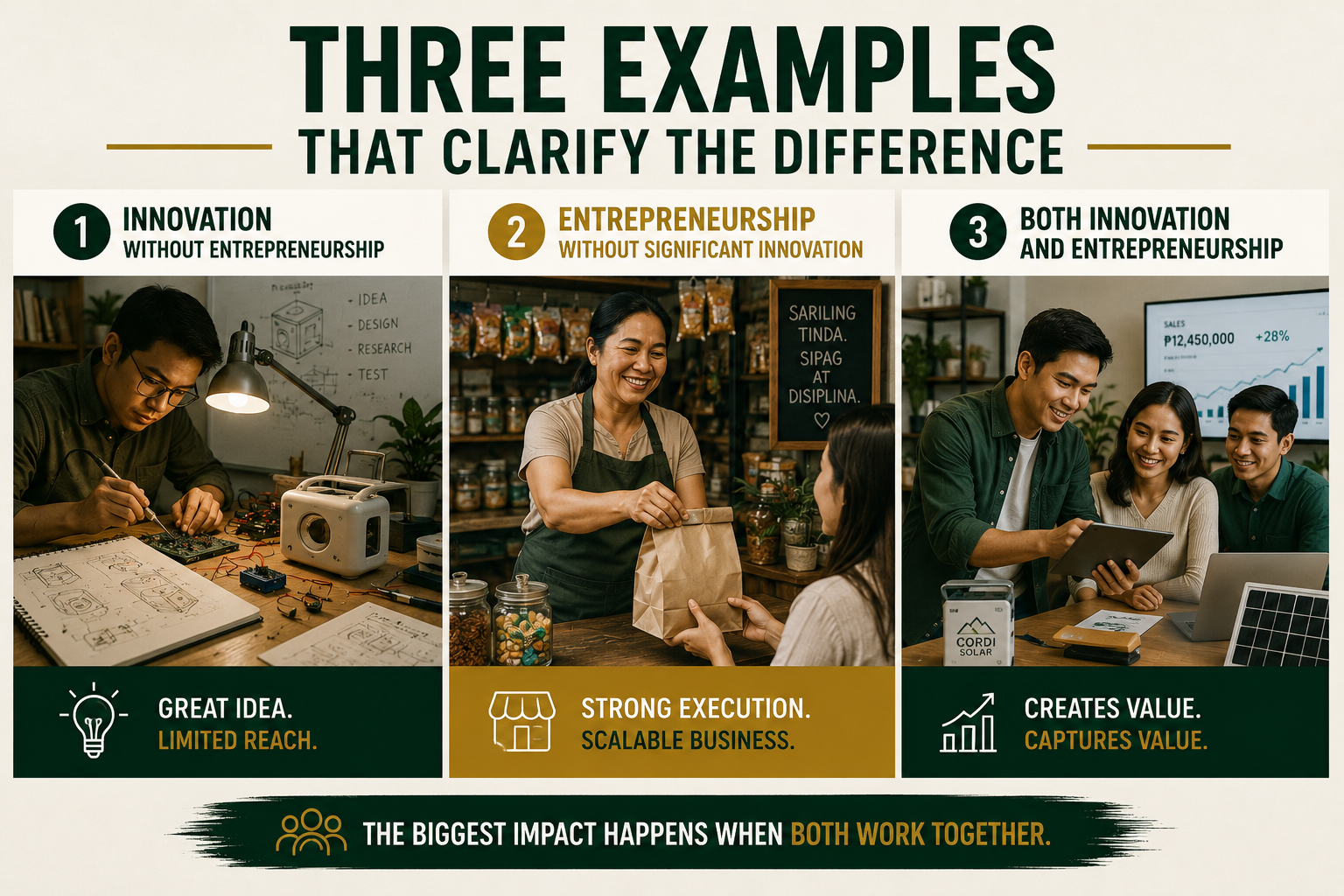
Nikola Tesla was one of history's greatest inventors. His contributions to electrical engineering helped shape the modern world. Yet despite his extraordinary innovations, Tesla struggled to build and sustain successful commercial ventures around many of his ideas. His innovations created tremendous value, but others were consistently more successful at capturing that value commercially.
Entrepreneurship Without Significant Innovation
Ray Kroc did not invent the hamburger. He did not invent fast food. What he did was recognize the opportunity within a small restaurant operation run by the McDonald brothers and build a scalable system that transformed it into a global company. His success came from entrepreneurship: execution, operations, systems design, franchising, and growth management.
Both Innovation and Entrepreneurship
Steve Jobs and Steve Wozniak combined both disciplines. They helped create products that changed industries while simultaneously building an organization capable of delivering those innovations at scale. The impact of Apple came from the combination — not from either discipline alone.
What This Means for Northern Luzon
In the Philippine context, innovation is often associated with technology startups, research projects, or highly technical inventions. While these are important, innovation takes many forms that are less visible but equally real:
A local MSME that digitizes its inventory system is innovating.
A tourism business that develops a unique community-based experience is innovating.
A logistics provider that redesigns its delivery process to reduce costs is innovating.
A food producer who develops a tree-to-bar production process from local cacao is innovating.
None of these require breakthrough technology. None require a venture capital investor or a university laboratory.
For emerging ecosystems like those growing across Baguio, Benguet, Ilocos, Pangasinan, Cagayan Valley, and the Cordillera, this distinction matters for a specific reason: founders should not feel that they need to invent the next global technology platform before they can start building. The most important question is not "Is this invention unprecedented?" It is "Does this create real value for real people, and can I build something sustainable around it?"
Many successful Filipino businesses began not with radical inventions but with strong execution and a deep understanding of local needs. A founder who solves a supply chain problem in Benguet agriculture, brings cold chain access to a municipality in Isabela, or builds a reliable delivery network in Pangasinan is practicing entrepreneurship — and may well be innovating in the process — without a single line of original code.
Four Misconceptions Worth Correcting
Misconception 1: Every entrepreneur must be an innovator.Many successful entrepreneurs build businesses around proven concepts. Their advantage comes from execution, customer understanding, distribution, or operational excellence — not from invention.
Misconception 2: Every innovation leads to a successful business.Many innovations never reach the market. Without customers, distribution, financing, and business execution, even the most promising innovations fail to generate impact. History is full of brilliant inventions that changed nothing because nobody built a business around them.
Misconception 3: Innovation means technology. New business models, service designs, operational processes, customer experiences, and partnerships can all be forms of innovation. The criterion is not the domain. It is whether something new or significantly improved was created that generates real value.
Misconception 4: Entrepreneurship is just starting a business.Starting a business is only the beginning. Entrepreneurship involves building something sustainable, creating consistent value for customers, managing resources, and continuously adapting to changing conditions. The starting is the easy part. The building is the work.
Why Ecosystem Builders Need to Hold Both
Strong startup ecosystems need both innovators and entrepreneurs, and they need programs, policies, and institutions designed to support both functions, not just one.
When ecosystems focus only on innovation, they produce great ideas with no path to adoption. Pitch competitions get won by the most technically impressive idea, not the most commercially viable one. Incubators fill up with prototypes that never reach customers. Research centers generate papers that never generate products.
When ecosystems focus only on entrepreneurship, businesses struggle to differentiate themselves. Execution without new value creation leads to competitive markets where everyone is selling the same things at lower and lower margins.
The goal is not to choose one over the other. The goal is to build environments where innovation and entrepreneurship reinforce each other: where a new idea can find a founder willing to build a business around it, and where a founder looking for an edge can find the innovation that gives their venture a durable advantage.
For ecosystem builders in Northern Luzon — LGUs designing innovation programs, TBIs structuring their intake, universities deciding what to put in entrepreneurship curricula, development organizations designing support programs — this distinction should inform every design decision. The question is not just "Are we supporting innovation?" or "Are we supporting entrepreneurship?" The question is: "Are we building the connective tissue between them?"
The Takeaway
Innovation and entrepreneurship are partners, not synonyms.
Innovation is about creating something better. Entrepreneurship is about bringing that improvement into the world and sustaining it. For founders, students, MSMEs, and ecosystem builders in Northern Luzon, understanding this distinction clarifies where to focus energy and resources at each stage of building.
A founder in the early stages of identifying a problem does not need to invent a breakthrough technology to justify starting. A researcher or innovator sitting on a promising process or product does not need to become a CEO overnight. What both need is a clear-eyed understanding of which function they are performing, what is still missing, and who or what can help fill the gap.
Because innovation may create value, but entrepreneurship is what transforms that value into lasting impact.
Comments
Leave a Comment
Community Contributions
Have a story to share?
Founders, researchers, and builders — submit your perspective.