
Baguio Used to Be on the Global Startup Map. It Is Not Anymore. That Should Bother Us More Than It Does.
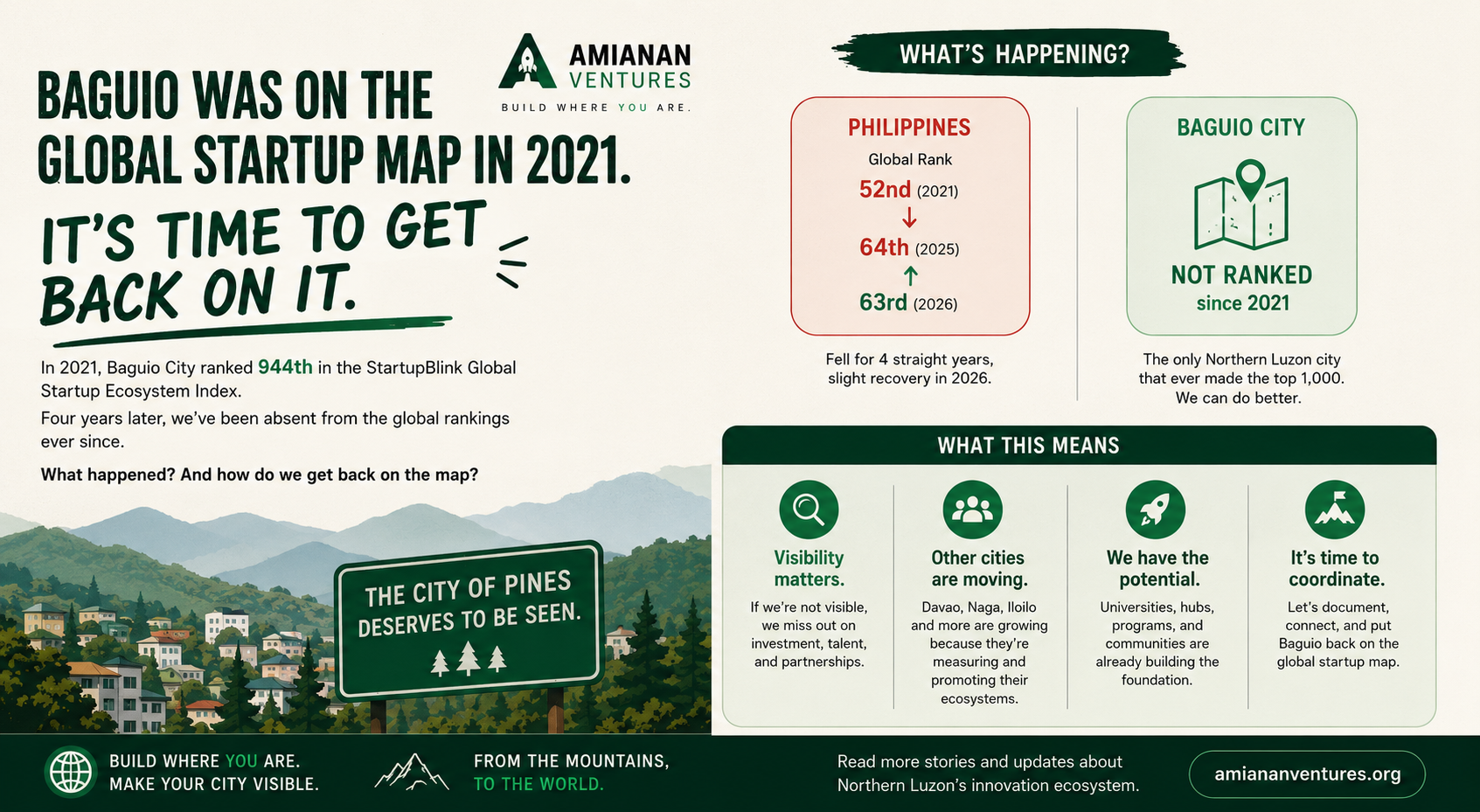
In 2021, Baguio City entered the StartupBlink Global Startup Ecosystem Index at 944th globally. By 2022, it had dropped off. The 2026 index just added two more Philippine cities, bringing the country's total to ten ranked cities. Baguio is still not one of them. That gap is not a data problem. It is a signal worth taking seriously.

Leandro Gepila
Founder / Co-founderInv8 Studio · cordillera
Product & Innovation Operator based in Baguio. I work with founders, institutions, and teams to turn ideas into validated products and build structured innovation programs that drive real outcomes.
 Featured
Amianan Ventures
In 2021, Baguio City appeared on the StartupBlink Global Startup Ecosystem Index for the first time, ranked 944th among 1,000 cities worldwide. It was a modest entry, but it was an entry. It meant that the global startup research community had enough evidence of activity in Baguio to register it as an ecosystem worth tracking. The Philippines that year ranked 52nd globally and 10th in all of Asia, a position that felt like the beginning of something.
Four years later, neither of those numbers holds. The Philippines has fallen in the global startup index for four consecutive years, slipping from 52nd in 2021 to 64th in 2025 before recovering slightly to 63rd in 2026. And Baguio, the only Northern Luzon city that ever made the global top 1,000, has been absent from the rankings every year since that first entry.
The 2026 Global Startup Ecosystem Index was released in May. Two new Philippine cities joined the index this year: Iligan City and San Mateo. The country now has ten cities ranked globally. Baguio is not one of them. And the cities that are on the list tell a story that Baguio's ecosystem should sit with.
The Philippine City Rankings: A Map of Who Is Moving
The current StartupBlink landscape for Philippine cities is worth examining in full, because the pattern of who is climbing and who is absent reveals where deliberate ecosystem investment is paying off.
The cities now ahead of Baguio on the global map include Manila at 121st, Cebu at 469th, Davao at 580th, Iloilo at 744th, Cagayan de Oro at 693rd, and Naga at 5th nationally. Cauayan City in Isabela and Solana in Cagayan entered the global rankings in 2025 at 1,040th and 1,170th respectively. In 2026, Iligan City and San Mateo joined them.
The trajectory of individual cities makes the picture even sharper. Davao grew its ecosystem score by 97.7% in a single year, jumping 163 spots globally from 743rd to 580th. Naga climbed 73 spots between 2023 and 2024 alone, building on three consecutive years of positive momentum. Even Manila, the country's dominant ecosystem, is growing at only 2.6% annually, the lowest rate among Philippine cities, as smaller cities accelerate past it in growth terms.
What these cities have that Baguio currently does not is a documented, indexed, externally visible startup ecosystem presence. Davao had an Investment Promotion Center actively measuring and communicating its ecosystem growth rate. Naga had city government support that translated activity into platform visibility. Iloilo made its global debut in 2025 at 744th, the same year Baguio remained absent.
What StartupBlink Actually Measures
Understanding why Baguio is off the map requires understanding what the index rewards. StartupBlink evaluates cities across three dimensions: quantity of startups registered in its database, quality of those startups based on factors like funding, global traction, and team size, and business environment measured by the presence of co-working spaces, accelerators, incubators, and government support infrastructure.
A city does not need to produce unicorns to rank. Cauayan City at 1,040th and Solana at 1,170th are proof of that. What a city needs is enough startups registered on the platform, enough support infrastructure listed, and enough ecosystem activity documented to meet the threshold for inclusion.
Manila's ecosystem is currently twelve times larger than Cebu City's on StartupBlink, and that gap has more than doubled since 2020. That concentration is a national problem, but it is also an opportunity for cities like Baguio that want to establish a distinct ecosystem identity rather than being absorbed into Metro Manila's gravitational pull.
What Baguio Has That Is Not Being Counted
The frustrating part of Baguio's absence from the rankings is that the city's startup and innovation activity is real and growing. Saint Louis University and UP Baguio signed an MOU in February 2026 to formalize collaboration on innovation, startup support, and knowledge sharing under the DOST-PCIEERD HEIRIT program. The University of Baguio held a Technology Business Incubator Seminar-Workshop in late 2024 and is developing a TBI roadmap. Siglat Youth Innovation Hub operates at the Baguio Convention and Cultural Center. The Bloomberg Philanthropies Youth Climate Action Fund selected Baguio as one of 300 cities globally. DICT-CAR runs startup tracks across the Cordillera under Project ACCESS.
None of this appears to be translating into StartupBlink visibility. The Baguio Startup Network website exists and positions the city as the innovation hub of the Cordilleras, but without a critical mass of indexed startups and listed infrastructure, the platform cannot register the ecosystem.
This is the gap: activity happening in Baguio that the global research infrastructure cannot see, because it has not been systematically documented in the databases that research platforms draw from.
The Visibility Problem Is the Ecosystem Problem
An ecosystem that cannot be seen globally is not fully functioning as an ecosystem. The conditions that produce a strong StartupBlink score, documented startups, active support infrastructure, and a visible business environment, are the same conditions that attract investment, talent, and partnerships from outside the local community. The ranking is a byproduct of building the ecosystem correctly. Absence from the ranking is a signal that something in the infrastructure is not working the way it should.
When Davao's ecosystem score grew by 97% in a single year, it was not because 97% more startups appeared overnight. It was because the city's investment in promotion, documentation, and platform presence made existing and new activity visible in ways the index could measure and reward. That is a replicable model. It does not require a massive budget. It requires coordination and intentionality.
The Philippines falling in the global index for four straight years before recovering slightly in 2026 reflects systemic issues: persistent infrastructure gaps and regulatory constraints that the national government has been slow to address. Baguio cannot fix the national ranking alone. But it can fix its own city ranking. And it has more than enough activity to justify being on the map.
What Getting Back on the Map Would Require
Getting Baguio back into the global top 1,000 is not a five-year project. It is a coordination project. The work involves:
Registering Baguio-based startups on StartupBlink and related platforms such as Crunchbase, so that the city's startup count reaches the threshold for inclusion
Listing co-working spaces, incubators, and accelerators operating in the city, including Siglat, the developing university TBIs, and any private co-working operations, with updated and accurate profiles
Coordinating between DICT-CAR, DOST-CAR, the City Government, and the universities to ensure that ecosystem activity is being tracked, measured, and communicated externally in a consistent format
Ensuring that the startups emerging from DICT and DOST programmes are being registered on global platforms as part of the programme completion process, not as an afterthought
None of this replaces the harder work of actually building strong startups. But it ensures that the startups being built here are visible to the investors, researchers, and partners who use global indices to identify ecosystems worth engaging with.
Baguio was on the global startup map in 2021. Iligan City and San Mateo joined it in 2026. The bar for inclusion is not out of reach. The question is whether the city's ecosystem institutions are ready to coordinate around getting back on it, and whether the founders, the universities, and the local government are willing to do the unglamorous work of documentation and platform presence that global visibility actually requires.
The City of Pines has been off the global startup map for long enough.
Comments
Leave a Comment
Community Contributions
Have a story to share?
Founders, researchers, and builders — submit your perspective.