
Your Bamboo Waste Is Worth More Than You Think. DOST Has a Kiln Technology That Turns It Into Charcoal, Industrial Vinegar, and a Market That Reaches Japan.
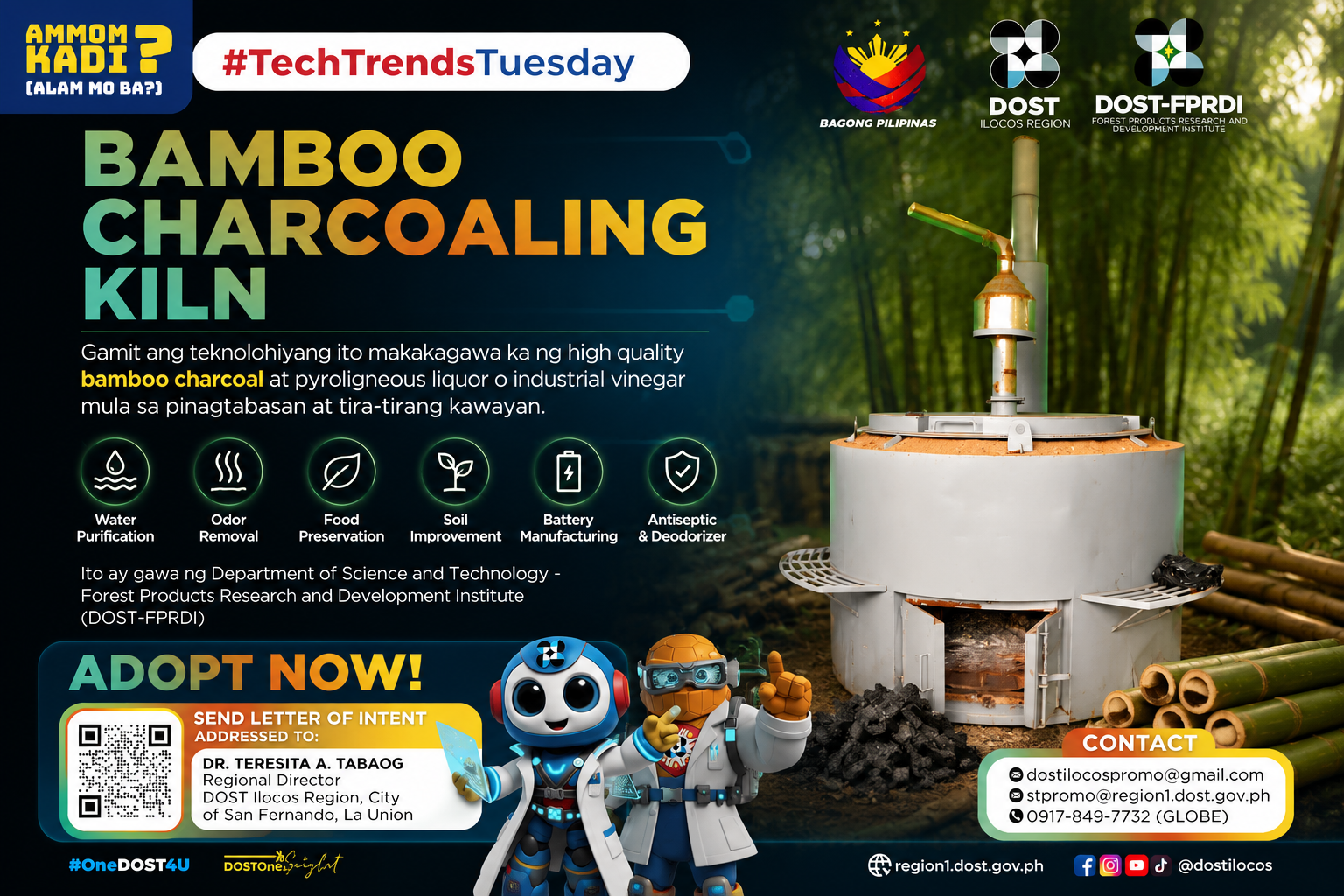
The DOST Forest Products Research and Development Institute developed the Bamboo Charcoaling Kiln Technology, which converts leftover and waste bamboo into high-quality bamboo charcoal and pyroligneous liquor, two products with documented commercial demand in water purification, electronics, food preservation, and personal care, and the technology is now open for adoption through DOST Ilocos Region.
 Featured Partner
Inv8 Studio
Innovation Partner for Startups & Growing Businesses
Every bamboo farm, bamboo furniture workshop, and bamboo construction site in Northern Luzon produces waste. Cut-offs, offcuts, rejected culms, the leftover material that piles up after every harvest or production run. Most of it gets burned in the open or left to decompose. None of that has to happen.
The Department of Science and Technology, through its Forest Products Research and Development Institute, developed the Bamboo Charcoaling Kiln Technology specifically to convert that waste material into two distinct commercial products: high-quality bamboo charcoal and pyroligneous liquor, also known as industrial vinegar. Both products have verified commercial applications. Both have documented demand in markets including Japan. And the technology is currently available for adoption by enterprises, cooperatives, and farmers across the Ilocos Region through DOST Ilocos Region.

What the Technology Produces
The Bamboo Charcoaling Kiln processes leftover and waste bamboo through controlled carbonization, producing two outputs from material that would otherwise have no commercial value.
Bamboo charcoal is a type of biochar with a wide range of industrial and consumer applications. Its high porosity and activated carbon properties make it effective for water purification and odor removal. In food production, it is used as a preservation agent. In manufacturing, it is a component in electronics and battery production. Japan has established commercial demand for bamboo charcoal across these applications, and the global biochar market is growing alongside rising demand for sustainable agricultural inputs and clean industrial materials.
Pyroligneous liquor, the liquid byproduct of the charcoaling process, is captured through a condensation tube during carbonization. It functions as a natural antiseptic, a deodorizer, an air purifier, and a skin and hair conditioner. It is also used in agriculture as a pesticide deterrent and soil conditioner. Industrial vinegar derived from bamboo charcoaling is a recognized input in Japanese organic farming and personal care product manufacturing, giving it a direct export market relevance for producers in Ilocos Region and across Northern Luzon.
Both products come from the same process, which means every batch of bamboo waste processed through the kiln generates two separate revenue streams simultaneously.
Why This Matters for Northern Luzon
Bamboo is one of the most widely distributed natural resources in Northern Luzon. The Cordillera, Ilocos Region, and Cagayan Valley all have significant bamboo populations, both cultivated and naturally occurring, and bamboo is deeply embedded in the traditional construction, craft, and livelihood practices of communities across the region.
The commercial challenge bamboo producers face is consistent: raw bamboo and basic bamboo products carry low margins, and waste from processing has historically had no value. The Bamboo Charcoaling Kiln addresses both problems simultaneously. It converts waste into a sellable product and adds a processing step that moves bamboo-based enterprises up the value chain from raw material supplier to finished goods producer.
For farmer-entrepreneurs and cooperatives in Ilocos Norte, Ilocos Sur, La Union, and Pangasinan, the kiln technology offers a pathway to two distinct high-value product categories without requiring new raw material investment. The input is what they are already discarding.
The Adoption Process
DOST-FPRDI has made the Bamboo Charcoaling Kiln Technology available for adoption by enterprises and organizations that want to implement it. The adoption process begins with a Letter of Intent addressed to Dr. Teresita A. Tabaog, Regional Director of DOST Ilocos Region, at the DOST Ilocos Region office in the City of San Fernando, La Union.
For questions about the technology, the adoption process, and what support DOST Ilocos Region provides to adopters, the S&T Promotions office can be reached directly:
Email: stpromo@region1.dost.gov.ph
Email: dostilocospromo@gmail.com
Phone: 0917-849-7732 (Globe)
Website: techub.dost.gov.ph
The DOST TecHub platform at techub.dost.gov.ph lists additional DOST-FPRDI and other agency technologies available for adoption across sectors, making it a useful starting point for any enterprise or cooperative exploring technology-based livelihood or production upgrades.
The Bigger Picture
The Bamboo Charcoaling Kiln is one example of a category of DOST-developed technologies that are specifically designed to add value to agricultural and forest byproducts that are currently being wasted across the region. The underlying logic is straightforward: Northern Luzon has natural resource abundance. The limiting factor is not the raw material. It is the processing technology and the market knowledge to convert that raw material into products that buyers in domestic and international markets will pay for.
DOST-FPRDI's role in this pipeline is to develop the technology and make it available. The role of enterprises, cooperatives, LGUs, and individual entrepreneurs in the region is to adopt it, implement it, and build the commercial operations around it. The adoption pathway is open. The technology is verified. The market for bamboo charcoal and pyroligneous liquor is documented.
For bamboo growers and bamboo-based enterprises across Northern Luzon looking at a pile of waste material at the end of every production run, the kiln is worth a closer look.
Original Source
Market Context
The global biochar market was valued at approximately USD 1.3 billion in 2023 and is projected to grow at a compound annual growth rate of over 13 percent through 2030, driven by demand for sustainable soil amendments, water filtration materials, and clean energy inputs. Japan is among the world's largest importers of bamboo charcoal and bamboo-derived industrial products, with verified commercial applications in personal care, agriculture, and electronics manufacturing. The Philippines has one of the highest bamboo densities in Southeast Asia, with an estimated 10.2 million hectares of potential bamboo cultivation area, yet bamboo processing and value-added manufacturing remain significantly underdeveloped relative to the country's raw material base. For Northern Luzon, which holds substantial bamboo resources across the Cordillera, Ilocos Region, and Cagayan Valley, DOST-FPRDI's Bamboo Charcoaling Kiln Technology represents a direct bridge between underutilized natural resource assets and a growing global market for bamboo-derived industrial products.
Are you a founder, innovator, or community builder in Northern Luzon?
We're always looking for compelling stories from the region's ecosystem. Whether you're launching a startup, running a program, or doing something interesting — we'd love to feature you.