
Ilocos Norte Is Digitalizing Barangay Records Across All 559 Villages. It Is the Foundation of Everything Else the Province Wants to Build.
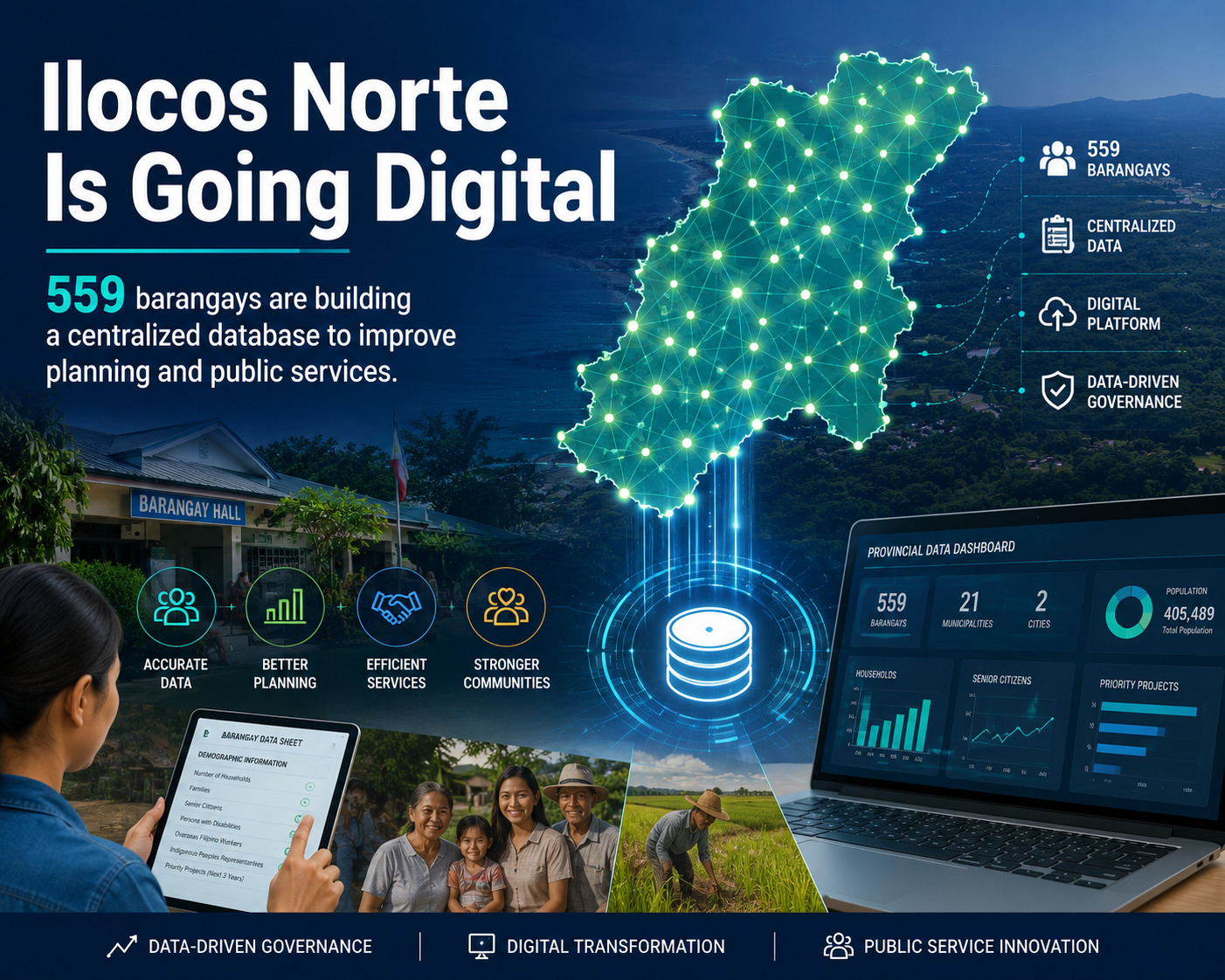
The Provincial Government of Ilocos Norte, through its Office of Barangay Affairs, is digitizing barangay data sheets across all 559 villages to create a centralized, reliable database that will improve public service delivery, reduce duplication in beneficiary records, and support evidence-based planning and budgeting at the local level.
 Featured
Amianan Ventures
Before a government can deliver services effectively, it has to know who it is serving. That sounds obvious. In practice, across most Philippine municipalities and provinces, the data needed to answer that question accurately is scattered across paper records, outdated spreadsheets, and inconsistently maintained barangay registries that vary in quality from one village to the next.
Ilocos Norte is working to change that. The provincial government, through the Office of Barangay Affairs, has launched an initiative to update and digitalize barangay data sheets across all 559 of its villages, covering every barangay in 21 municipalities and two cities. The goal is a centralized, reliable database that local officials can actually use for planning, budgeting, and targeting development programs, rather than working from estimates or incomplete records.
It is not a headline-grabbing initiative. It is the kind of infrastructure work that determines whether everything else the government tries to do actually reaches the people it is meant for.
What Is Being Collected and Why It Matters
Each barangay is completing an online questionnaire gathering the demographic and development data that local governments need but rarely have in clean, current form. The data points include the number of barangay workers, households, families, senior citizens, persons with disabilities, overseas Filipino workers, Indigenous Peoples representatives, and each village's priority development projects for the next three years.
That last item, priority projects for the next three years, is particularly significant. A provincial government that has village-level development priorities from all 559 barangays in a single accessible database has something most provinces do not: the raw material for genuinely bottom-up planning. Instead of provincial officials estimating community needs from the center, the database gives them a direct view of what each village says it needs, weighted by the demographic context that determines what kind of intervention is appropriate.
Katrina Agulay of the OBA articulated the operational value directly: "Having comprehensive barangay data will contribute to the efficient delivery of services and help minimize errors, such as avoiding the duplication of beneficiary records." That last point is not a minor detail. Duplication in beneficiary records is one of the most persistent inefficiencies in Philippine social service delivery. When the same household is counted twice, someone else who should be counted once gets left out. A clean, centralized database is the most direct fix for that problem.
The Coordination Problem This Solves
Provincial Association of Barangay Councils President Ryan John Pascua framed the urgency clearly: "There is a need to update the barangay data sheet to speed up the delivery of government services at the grassroots level."
The current state, in Ilocos Norte as in most Philippine provinces, is one of fragmented coordination. Barangay officials maintain their own records in their own formats. Municipal and city governments aggregate what they can. The provincial government works with whatever makes it up to that level, filtered through two layers of data quality that it does not directly control. When national programs require beneficiary lists, the province compiles what it has. The gaps and duplications are a structural consequence of a system that was never designed for the kind of targeted, evidence-based delivery that modern governance requires.
A centralized provincial database, built from standardized online questionnaires submitted directly by barangay officials, removes several of those layers. It creates a single source of record that the province, municipalities, and barangays can all reference. It makes coordination faster because everyone is working from the same data. And it makes accountability cleaner because discrepancies are visible rather than buried in paper records in 559 separate offices.
Where This Fits in Ilocos Norte's Broader Digital Agenda
This initiative is not happening in isolation. In January 2026, the provincial government began migrating to a new digital system designed to enhance digital infrastructure, strengthen data security, and improve e-governance services for local government offices, schools, businesses, and remote communities. The barangay data digitalization effort is the village-level component of that broader migration, building the data foundation that the province's new digital infrastructure is designed to use.
The sequencing matters. Digital governance infrastructure without quality data is a system with nothing meaningful to process. Quality data without digital infrastructure is a spreadsheet that nobody can access when they need it. Ilocos Norte is building both layers in parallel, and the barangay digitalization initiative is the layer that determines whether the whole system has the inputs it needs to function.
What This Means Beyond Ilocos Norte
Ilocos Norte's barangay data digitalization initiative is a model that deserves attention from every LGU across Northern Luzon working to improve service delivery and governance.
The problem it is solving, fragmented, outdated, and inconsistent village-level records, is not specific to Ilocos Norte. It is one of the most universal governance challenges across Philippine provinces and municipalities, and it is one of the most foundational. Every program targeting senior citizens, PWDs, Indigenous Peoples, or OFW households depends on knowing who and where those populations are. Every budget allocation for barangay infrastructure depends on having a current picture of community needs. Every assessment of whether a government program is working depends on having a baseline that is accurate enough to measure against.
The initiative also demonstrates what it looks like when a provincial government treats data as infrastructure rather than paperwork. The distinction is important. Paperwork is a compliance burden: something you fill out because the form requires it. Infrastructure is something you invest in because everything you want to build later depends on it.
Ilocos Norte is building infrastructure. For LGUs across the Ilocos Region, the Cordillera, and the rest of Northern Luzon watching what data-driven governance looks like in practice, this is one of the clearest examples available right now.
Original Source
This article is based on the report by Mary Therese D. Ancheta published by the Philippine Information Agency on June 8, 2026, titled "Ilocos Norte advances data-driven governance through barangay data digitalization." We are grateful for the original reporting that brought this story to light.
Market Context
The Philippine government's national digital transformation agenda, formalized through Executive Order 170 and the Department of Information and Communications Technology's Digital Philippines program, explicitly includes local government units as key implementation partners for e-governance services and data-driven public administration. The barangay, as the smallest and most immediate unit of Philippine government, is simultaneously the most important source of ground-level demographic and needs data and historically the most underfunded and under-digitalized level of government. Provinces that invest in standardizing and centralizing barangay data create a compounding governance advantage: more accurate targeting of social services, faster distribution of benefits, cleaner audit trails for development programs, and more credible inputs for provincial and municipal development planning. For Northern Luzon, where agricultural, indigenous, and remote communities are often the most underserved and the hardest to reach with government services, accurate village-level data is a prerequisite for the kind of responsive, evidence-based governance that closes the gap between national policy and community-level impact.
Are you a founder, innovator, or community builder in Northern Luzon?
We're always looking for compelling stories from the region's ecosystem. Whether you're launching a startup, running a program, or doing something interesting — we'd love to feature you.