
IFSU-Hapao Turned Heirloom Rice Into Ice Cream and Taught a Community of Women How to Build a Business From It.
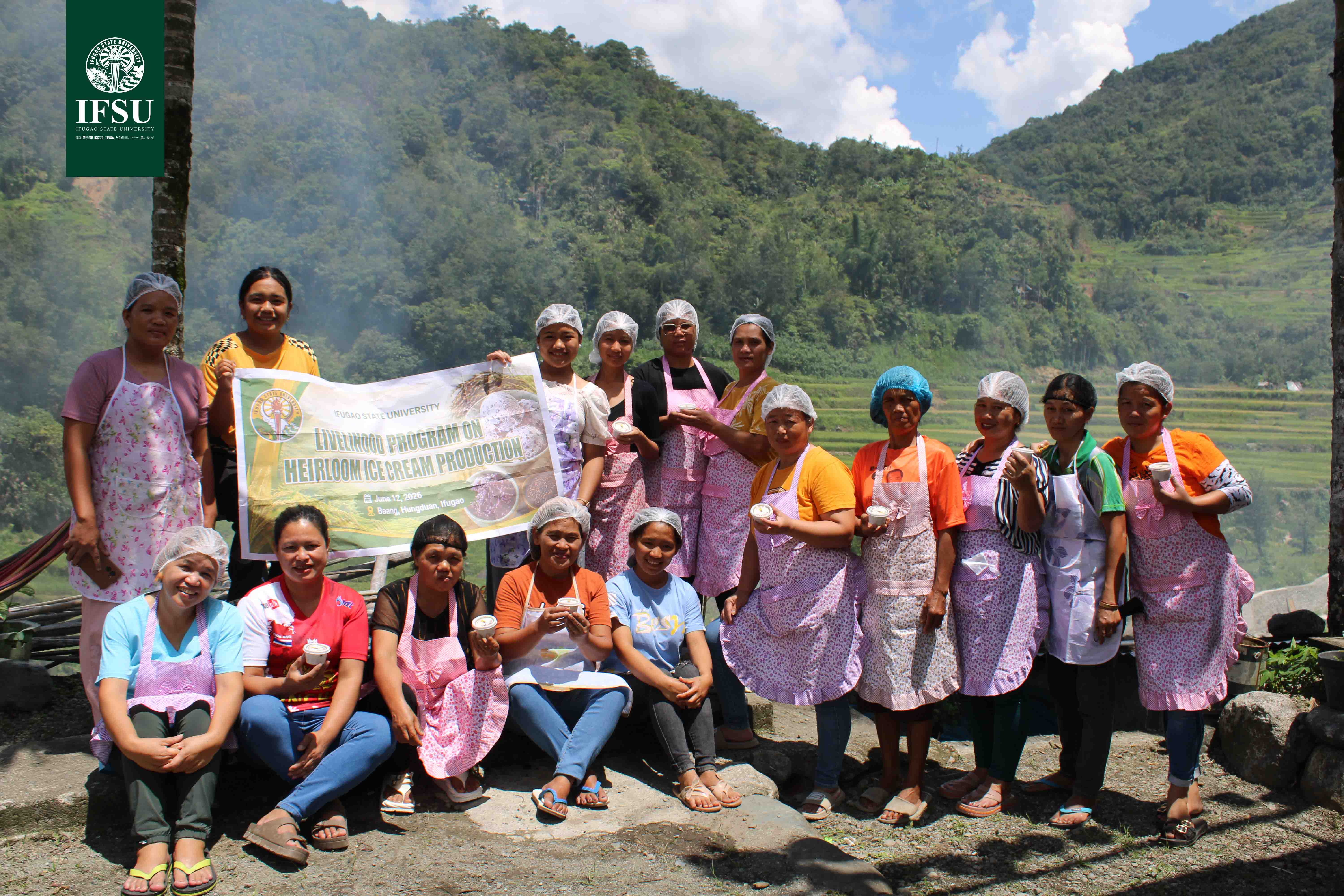
Ifugao State University's Hapao Campus conducted a specialized livelihood training on Heirloom Rice Ice Cream Production on June 12, 2026, directly benefiting members of the Baang Food Processing Organization, with a focus on equipping local women and mothers with commercial production skills rooted in the Cordillera's indigenous agricultural heritage.
 Featured
Amianan Ventures
Ifugao's heirloom rice is one of the most culturally significant agricultural products in the Cordillera. It is grown in the same terraced fields that UNESCO recognized as a World Heritage Site, using traditional farming methods passed down across generations. It commands premium prices in domestic specialty markets and growing interest in export channels. And until recently, most of the value it generates flows past the farming communities that grow it.
Ifugao State University's Hapao Campus is working to change that one product at a time. On June 12, 2026, the campus conducted a specialized livelihood training program on Heirloom Rice Ice Cream Production for members of the Baang Food Processing Organization, with a particular focus on empowering local women and mothers with the skills and confidence to move into commercial production.
The product is not a gimmick. It is a value-added application of an internationally recognized ingredient, designed for a food enterprise that a community organization can operate, scale, and sustain.

What the Training Covered
The session was structured to give participants both the technical knowledge and the food safety foundation needed for commercial production, not just home preparation.
Ms. Generose Dulnuan led the technical session, walking participants through the standard materials and step-by-step methods of heirloom rice ice cream production. The progression from raw ingredient to finished product involves specific techniques at each stage, and the training was designed to build a replicable, consistent production process that participants can apply independently after the session.
Ms. Sarah G. Ipan complemented the technical demonstration with a session on proper food handling and strict safety practices. For a food enterprise targeting commercial sale, food safety compliance is not optional. It is the baseline requirement for market access, for institutional buyers, and for the consumer trust that determines whether a food product builds a loyal customer base or loses it after the first batch. Teaching food safety alongside production technique is the difference between training that produces a kitchen skill and training that produces a commercially viable operation.
Engr. Ronalyn B. Duyapat, the project's lead proponent, closed the session with a direct challenge to the participants: maximize the skills acquired and venture into commercial production. "With the comprehensive re-skilling activities provided, the beneficiaries are now well-equipped and confident to produce high-quality heirloom rice ice cream, which will serve as a viable source of sustainable income," she said.
Why Heirloom Rice Ice Cream Is a Viable Enterprise
The combination of heirloom rice and ice cream is not an arbitrary product choice. It works because of what heirloom rice brings to the formulation and to the story.
Heirloom rice varieties from Ifugao carry distinct flavor profiles that differ meaningfully from commercial rice: nuttier, earthier, with aromatic qualities that depend on the variety and the terroir of the specific terrace system where they were grown. Those characteristics translate into an ice cream product that tastes different from any mass-market offering and that carries a provenance story that no factory in Metro Manila can replicate.
For the specialty food market, for tourism, and for the growing domestic appetite for authentically local food products, heirloom rice ice cream sits at the intersection of three trends that are all moving in the same direction: premiumization of indigenous ingredients, growing consumer interest in culturally rooted food experiences, and increasing willingness to pay more for products with a verified place-based identity.
The Baang Food Processing Organization, with the production knowledge acquired through this training, is now positioned to offer exactly that kind of product.
The Women at the Center of This Initiative
BFPO President Ms. Perjoy Liwongan expressed gratitude to IFSU-Hapao Campus for its continued assistance, noting that capacity-building activities like this are crucial for strengthening the organization's livelihood initiatives and fostering self-reliance among members.
That framing, self-reliance as the goal rather than dependency on continued institutional support, is the right one. A training program that produces a community of producers who can operate independently, make their own production decisions, manage their own quality standards, and develop their own market relationships is a fundamentally different outcome than one that creates dependency on the organizing institution.
The focus on women and mothers is also a specific economic development choice, not an incidental detail. Women in Cordillera farming communities are often the primary managers of household food production and the primary participants in community-based livelihood organizations. Building their technical and commercial skills directly is the most efficient pathway to household income improvement and to the kind of community-level economic resilience that the initiative's SDG alignment reflects.
The training directly contributes to four United Nations Sustainable Development Goals: SDG 1, addressing poverty through livelihood creation; SDG 5, advancing gender equality through women's economic empowerment; SDG 8, supporting decent work and economic growth; and SDG 12, promoting responsible production using culturally and ecologically grounded ingredients.
What IFSU-Hapao Is Demonstrating for the Cordillera
IFSU's Hapao Campus is a regional university with a mandate that extends beyond producing graduates. Its extension function, the university's role in serving its surrounding communities through research, technical assistance, and livelihood support, is one of the most direct levers available for connecting the Cordillera's indigenous agricultural heritage to commercial markets.
The heirloom rice ice cream training is one example of what that connection looks like in practice. The university provides the technical expertise, the food safety knowledge, and the institutional credibility. The community organization provides the local knowledge, the social infrastructure, and the labor. The product that results from that partnership carries both: the scientific rigor of university-backed production standards and the cultural authenticity of ingredients grown in Ifugao's UNESCO-recognized rice terraces.
For other universities in the Cordillera and across Northern Luzon, this model is worth studying. The most valuable contribution a regional university can make to its surrounding economy is not always a published paper or a new degree program. Sometimes it is a two-day training that gives a group of women the specific skills they need to turn a culturally significant ingredient into a sustainable source of income.
Original Source
Market Context
The Philippines' heirloom rice sector has been gaining domestic and international market attention over the past decade, driven by growing consumer interest in indigenous food varieties, sustainable agriculture, and culturally authenticated food products. Ifugao heirloom rice varieties are grown in the Ifugao Rice Terraces, a UNESCO World Heritage Site, giving them a geographic and cultural provenance that commands premium pricing in specialty retail channels. The global premium ice cream market is growing at approximately 5 percent annually, with artisan and culturally distinct flavors among the fastest-growing subcategories. For Cordillera-based food enterprises, value-added products that combine indigenous ingredients with modern food production formats represent a direct pathway to higher-margin markets that traditional raw ingredient sales cannot access. IFSU-Hapao Campus's extension programs in community livelihood development are part of a broader network of Cordillera university outreach initiatives that collectively form one of the region's most important informal infrastructure systems for agricultural value-chain development.
Are you a founder, innovator, or community builder in Northern Luzon?
We're always looking for compelling stories from the region's ecosystem. Whether you're launching a startup, running a program, or doing something interesting — we'd love to feature you.