
From hometown kitchens to global standards: five Region 2 MSMEs achieve HACCP certification
DTI Region 2’s Export Industry Development Program helps Cagayan Valley food enterprises upgrade their operations to Codex-based safety systems, bringing local favorites one step closer to supermarket shelves here and abroad.
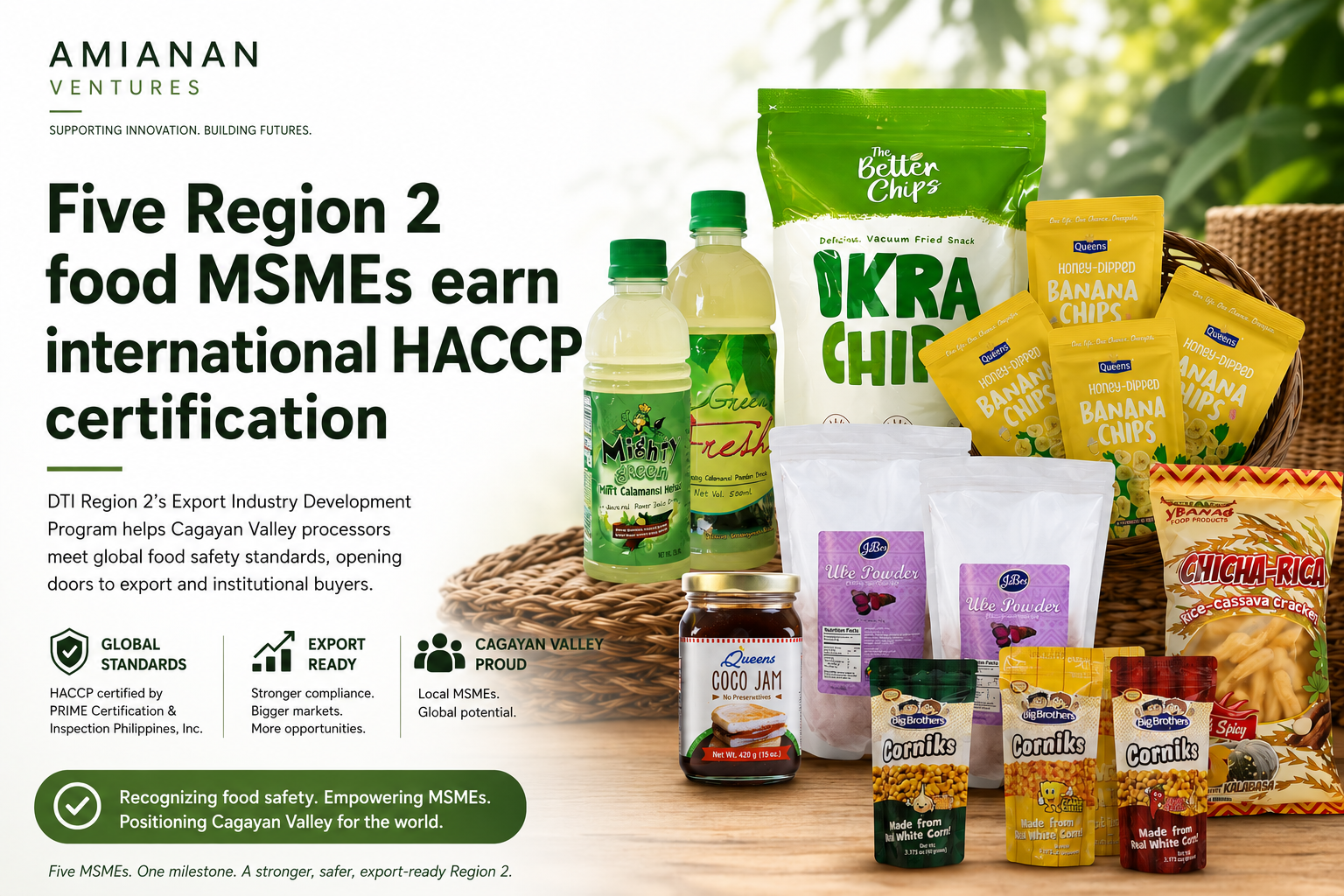
 Featured
Amianan Ventures
Region 2 MSMEs hit HACCP milestone
Five micro, small, and medium food enterprises in Region 2 have secured international HACCP certification under the Department of Trade and Industry Region 2’s Export Industry Development Program, signaling that Cagayan Valley processors are ready to play in higher-value markets, not just local retail.
Certification details and who is involved
The certifications, issued by PRIME Certification and Inspection Philippines, Inc., are based on the Codex Alimentarius “General Principles of Food Hygiene” (CXC 1-1969), which set out global hygiene and HACCP guidelines for food business operators across the supply chain. These standards are recognized worldwide and provide a common language for regulators and buyers assessing food safety systems.
The certified enterprises span a mix of staple and specialty products: Quirino Young Entrepreneurs Association for Ube powder processing, OneAsia Trader for banana fruit and coco jam, 3Shers Food Products for cornicks, JBM Food Products for food and beverage lines, and Lighthouse Cooperative for rice-cassava crackers. Together, they show that HACCP is achievable for cooperatives and MSMEs working with everyday local products, not only for large Metro Manila factories.
How DTI Region 2 is building export readiness
DTI Region 2’s Export Industry Development Program is designed to move MSMEs from informal, low-margin production into structured, standards-based operations through technical assistance, capacity-building, and industry-led interventions. Nationally, DTI has highlighted that MSMEs joining major export shows can generate multi-million peso sales when properly supported; one recent food export trade show saw 24 MSMEs collectively generate around 15 million pesos in sales, beating earlier regional performance. For Region 2, upgrading food safety systems through HACCP is a direct way to plug local processors into such opportunities.
HACCP adoption is also reinforced by national policy. The Food Safety Act encourages food business operators to implement HACCP-based systems, and sector-specific rules already require HACCP for “AAA” meat establishments that want to export. Government and industry studies note that small food companies often struggle with HACCP because of limited resources and technical capacity, which is why targeted support from DTI and partner agencies is critical to help MSMEs close the knowledge and infrastructure gaps.
Why this matters for Northern Luzon founders
For Northern Luzon’s broader food and agribusiness ecosystem, these certifications are an important reference point. They show that provincial processors can compete on safety and reliability, not just price, and they set a benchmark for TBIs, HEIs, and LGUs in neighboring regions that want their MSME clients to reach export readiness. If more MSMEs treat HACCP as a strategic goal, the region can gradually shift from selling raw commodities into exporting branded, processed goods that carry Cagayan Valley’s name into overseas markets.
The national MSME Development Plan 2023–2028 identifies access to global markets and compliance with standards as key levers for MSME growth, underlining the importance of food safety certifications for enterprises that want to move up the value chain. Internationally recognized HACCP certification gives buyers and regulators confidence that a producer has systematically identified hazards, set critical limits, and built monitoring and verification routines, which is why service providers and certifiers position HACCP as a core requirement for organizations that manufacture food, ingredients, and beverages for export.
For founders and cooperative leaders in agritech and food innovation, the practical takeaway is clear: upgrading packaging and branding is not enough. The next step is to map current processes against HACCP requirements, identify the gaps, and use DTI programs and local partners to close them. Certification is hard work, but these five MSMEs show it is possible, and that it unlocks new market access, stronger buyer confidence, and a more resilient business.
Original Source
Market Context
HACCP is an internationally recognized standard for controlling food safety hazards, built into Codex hygiene principles and widely used by regulators and buyers to assess food manufacturers. In the Philippines, national legislation encourages HACCP-based systems for food operators and makes HACCP mandatory for certain export-oriented meat establishments, underscoring its role as a gateway requirement for global trade.
MSMEs account for the vast majority of registered businesses in the country and are central to job creation, which is why government plans explicitly call for stronger support to help them meet international standards and access foreign markets. When regional programs like DTI Region 2’s Export Industry Development Program combine standards training, process upgrades, and certification support, they directly address the barriers identified in studies of small-scale food companies, including limited technical knowledge, financial constraints, and weak hygiene infrastructure.
Are you a founder, innovator, or community builder in Northern Luzon?
We're always looking for compelling stories from the region's ecosystem. Whether you're launching a startup, running a program, or doing something interesting — we'd love to feature you.