
The US, Japan, and the Philippines Are Building the Luzon Economic Corridor. Northern Luzon Is Not Just a Bystander. Here Is Why It Should Be Paying Attention.
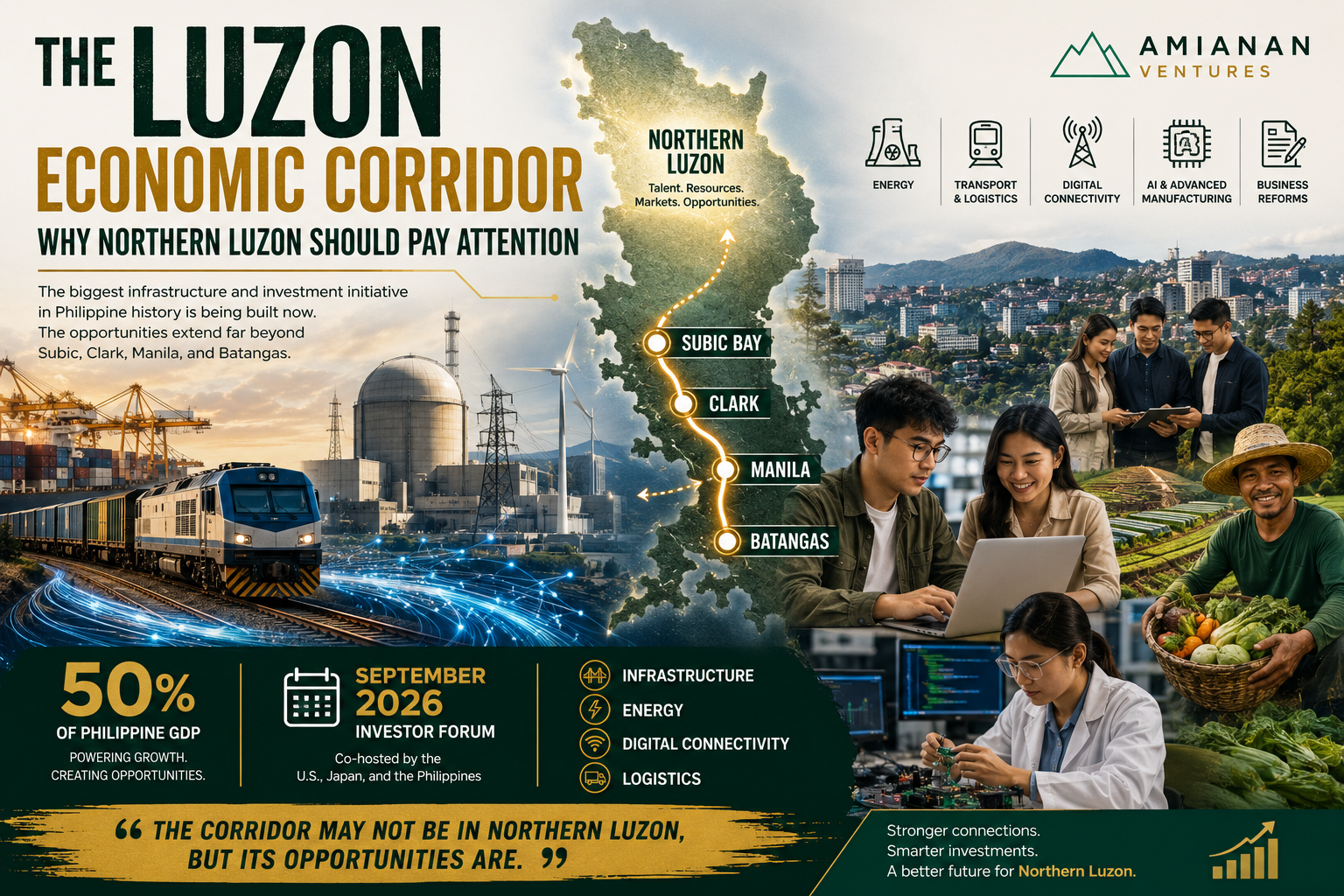
The Luzon Economic Corridor, a trilateral initiative connecting Subic Bay, Clark, Manila, and Batangas, is mobilizing billions in investment across energy, transport, digital infrastructure, and advanced manufacturing on the island of Luzon. The first Investor Forum is scheduled for September 2026. For founders, enterprises, and local governments in Northern Luzon, the corridor's upstream effects in logistics, digital connectivity, energy access, and supply chain integration are the most immediate opportunities on the table.
 Featured
Amianan Ventures
The United States, Japan, and the Philippines formally established the Luzon Economic Corridor as a trilateral infrastructure and investment initiative connecting four of Luzon's most economically significant nodes: Subic Bay, Clark, Manila, and Batangas. The corridor now counts Australia, Canada, Denmark, France, Italy, South Korea, Sweden, and the United Kingdom as partner countries. The first Luzon Economic Corridor Investor Forum, to be co-hosted by the three founding governments, is scheduled for September 2026.
The corridor accounts for approximately 50 percent of Philippine GDP. Its investment pipeline spans nuclear energy, freight rail, undersea cables, 5G deployment, cold chain logistics, an AI-native economic security zone, and a suite of legal reforms including 99-year lease terms for investors, a 40-year fiscal incentive window under the CREATE MORE Act, and a stock transaction tax reduction from 0.6 to 0.1 percent.
This is the largest coordinated foreign investment mobilization in Philippine history. Northern Luzon is not inside the corridor's four anchor nodes. But the assumption that it is therefore irrelevant to what is being built would be the wrong read.
What the Corridor Is Actually Building
The LEC's investment portfolio spans five major sectors, each with direct upstream and downstream relevance to the economies of Northern Luzon.
Energy is the most technically ambitious component. The US and the Philippines signed a civilian nuclear cooperation agreement, and the US Trade and Development Agency is funding a USD 2.7 million feasibility study for small modular reactor deployment through Meralco. A nuclear reactor control room simulator is being established to position the Philippines as an SMR regional training hub, supported by AboitizPower, TESDA, and the US State Department. Academic partnerships with Texas A&M University and King's College London will develop SMR curricula for Philippine engineering programs. Separately, the Energy Secure Philippines program received more than USD 24 million in US funding to upgrade power systems, deploy microgrids, and improve grid integrity across Luzon. A 45-mile fuel pipeline connecting Subic Bay to Clark is in feasibility study, backed by the US State Department.
Transport and logistics centers on the Subic-Clark-Manila-Batangas freight railway, a proposed 132-mile line connecting three of the Philippines' most critical ports. USTDA and Sweden's Swedfund are funding technical assistance for this project. Japan is developing the North-South Commuter Railway connecting Calamba to Clark International Airport, with a feasibility study underway for an extension further north to Tarlac City. A 30-year railway master plan for the greater capital region through 2055 is also being funded by Japan.
Digital connectivity includes 1,000 kilometers of fiber optic network already rolled out across Luzon by HGC, a US private equity portfolio company, connecting major data centers, cable landing stations, and central business districts. USTDA awarded a grant to RISE Inc. for a feasibility study on expanding internet exchanges to underserved communities. Smart Communications received USTDA support for 5G deployment training aimed at reaching 96 percent of the country's population. Japan and the Philippines are co-creating an AI ecosystem through the ASEAN-Japan Co-Creation Initiative for AI.
Advanced manufacturing includes a planned 4,000-acre economic security zone in the LEC, designed as the first AI-native investment acceleration hub under the Pax Silica Initiative, targeting semiconductor and allied manufacturing. Collins Aerospace is expanding its manufacturing operations in Batangas with a new 7,846-square-meter facility.
Business environment reforms include lease terms extended to 99 years under the amended Investors' Lease Act, up to 40 years of fiscal incentives for strategic investments under the CREATE MORE Act, the new Public-Private Partnership Code, the Accelerated Right-of-Way Act, and a Capital Markets Efficiency Act reducing stock transaction tax to 0.1 percent.
What Northern Luzon Should Be Paying Attention To
The LEC's four anchor nodes are Subic, Clark, Manila, and Batangas. None of them are in Ilocos Region, the Cordillera, or Cagayan Valley. But infrastructure investment of this scale does not stay contained within its designated boundaries.
Digital connectivity is the most direct opportunity. The 5G deployment push targeting 96 percent of the country's population and the expansion of internet exchanges to underserved communities are programs with direct applicability to the connectivity gaps that define the operating environment for startups and MSMEs across Northern Luzon. HGC's 1,000-kilometer fiber rollout across Luzon is already extending beyond the corridor's core nodes. The undersea cable landing stations and backbone infrastructure being built for Metro Manila and Clark create the upstream capacity that provincial digital expansion draws from. Every improvement to Luzon's digital backbone reduces the cost and improves the reliability of connectivity for businesses operating in Baguio, Tuguegarao, Laoag, and every municipality in between.
The North-South Commuter Railway extension to Tarlac and the 30-year railway master plan are the transport investments most directly relevant to Northern Luzon. Tarlac is the gateway to the north. A freight and passenger rail connection that reaches Clark and eventually Tarlac meaningfully reduces the logistics friction for enterprises in Pangasinan, La Union, and the Ilocos Region that currently depend entirely on road transport to access Metro Manila markets. The feasibility study for the Tarlac extension is underway. The 30-year master plan covers through 2055. Northern Luzon's LGUs and chambers of commerce have a direct interest in ensuring that the region's logistics connectivity needs are represented in both planning documents.
The energy investments create workforce and supply chain opportunities. The SMR training hub, the nuclear curricula being developed for Philippine engineering programs, and the TESDA-supported vocational programs for the civil nuclear sector are workforce development pipelines that Northern Luzon's universities and technical schools can connect to. Mariano Marcos State University, Cagayan State University, Benguet State University, Saint Louis University, and the University of the Cordilleras all have engineering and technical programs that are positioned to integrate nuclear and advanced energy curricula if they engage with the programs being established. The workforce being trained for the corridor's energy sector does not have to come exclusively from schools inside the corridor.
The CREATE MORE Act's 40-year fiscal incentive window and the Investors' Lease Act's 99-year lease terms apply to registered investment projects across the Philippines, not only within the LEC's four nodes. Northern Luzon enterprises and LGUs pursuing investors in agritech, renewable energy, tourism infrastructure, and digital services can reference these frameworks directly in investment conversations. The legal environment for long-term foreign and domestic investment in the Philippines is now materially better than it was three years ago, and that improvement applies everywhere on the island of Luzon.
The September 2026 Investor Forum is the most time-sensitive signal. The first LEC Investor Forum, co-hosted by the US, Japan, and the Philippines, will be the most concentrated gathering of international investors with Luzon mandates that has ever been assembled. Northern Luzon's regional investment promotion offices, industry associations, and LGU economic development teams have a specific, time-bound opportunity to position the region's assets, agricultural supply chains, tourism infrastructure, renewable energy potential, and human capital within the investment conversations that will be happening in that room.
What This Means for Founders and MSMEs
For early-stage founders and MSMEs in Northern Luzon, the LEC is not primarily a story about airports and nuclear reactors. It is a story about the infrastructure conditions that determine whether a business built in the region can compete in the markets that are forming around that infrastructure.
Better logistics connectivity between Northern Luzon and Metro Manila, Clark, and Subic lowers the cost of getting products to market. Expanded digital infrastructure reduces the cost of operating, marketing, and selling from a provincial location. A more competitive investment environment brings capital that is looking for opportunities beyond the corridor's saturated core nodes. A workforce trained in advanced energy and digital technologies that stays in the region rather than migrating to Manila is the human capital that the next generation of Northern Luzon enterprises will be built on.
The corridor is being built right now. The September 2026 Investor Forum is the first major convening around it. Northern Luzon has the assets, the talent, and the problems worth solving that international investors will be looking for. The question is whether the region's founders, institutions, and local governments will show up in that conversation or wait to hear about it secondhand.
Original Source
Market Context
The Luzon Economic Corridor accounts for approximately 50 percent of Philippine GDP, making it the country's most concentrated economic geography. International infrastructure investment of this scale in a single island economy historically produces significant second-order effects in regions adjacent to the primary investment nodes, particularly in logistics costs, labor market wages, and digital service access. The Philippines' CREATE MORE Act, Investors' Lease Act, and Capital Markets Efficiency Act collectively represent the most significant improvement to the country's investment regulatory environment in more than a decade, creating conditions that apply nationally and not only within the corridor's designated boundaries. For Northern Luzon, which contributes significantly to Philippine agricultural output, tourism receipts, and mineral production but receives a disproportionately small share of infrastructure investment relative to its economic contribution, the LEC's upstream infrastructure development represents the most credible near-term pathway to reduced logistics costs and improved market access for regional enterprises.
Are you a founder, innovator, or community builder in Northern Luzon?
We're always looking for compelling stories from the region's ecosystem. Whether you're launching a startup, running a program, or doing something interesting — we'd love to feature you.