
The Lean Startup: A Practical Guide for Filipino Founders
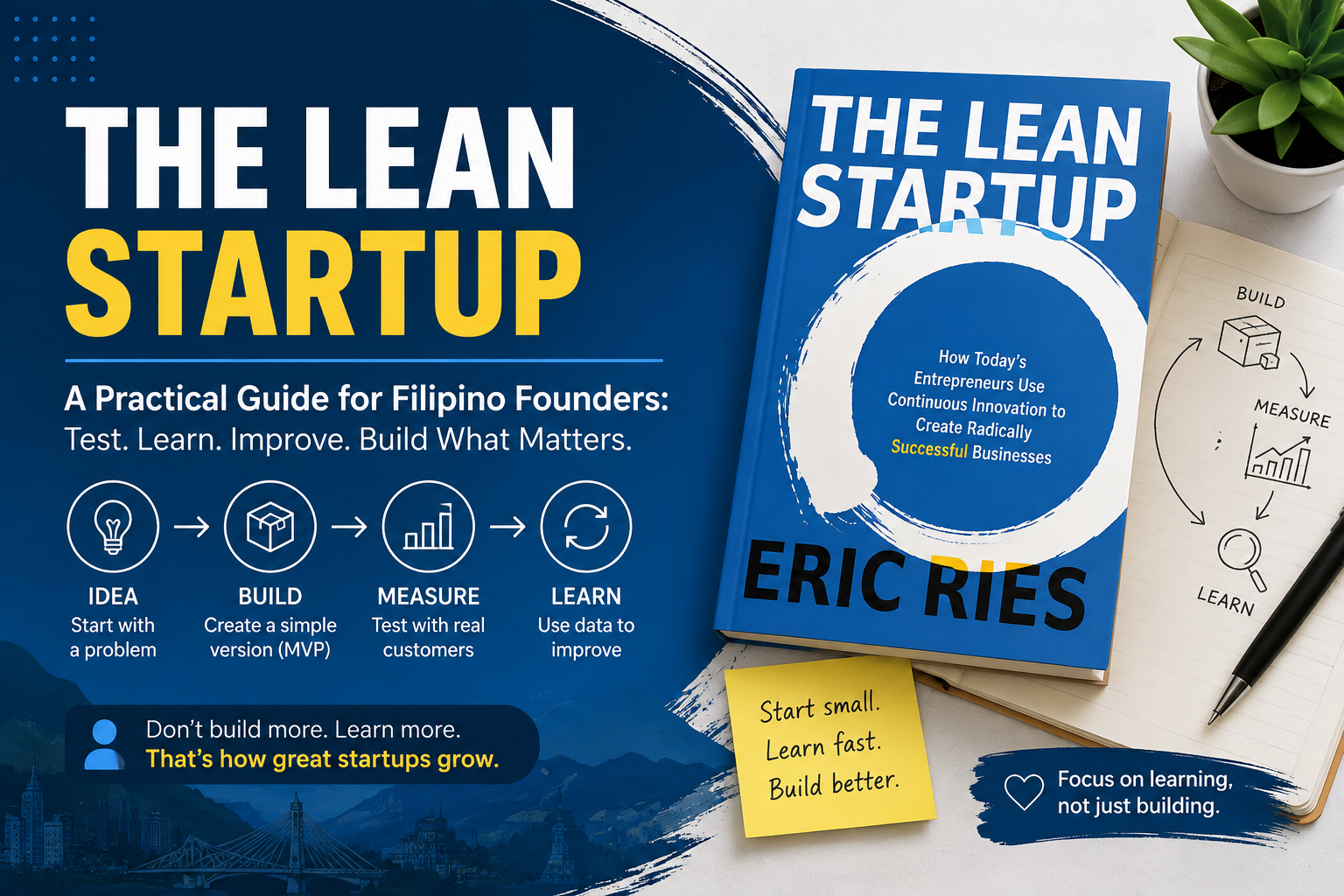
Eric Ries’ The Lean Startup teaches a simple but powerful idea: don’t spend too much time building something before knowing if people actually want it. Instead, test your assumptions early, learn from real customers, and improve your business based on evidence.
 Featured
Amianan Ventures
Your Idea Is Not Yet a Business
Most founders start with an idea.
Maybe you noticed a problem in your community. Maybe you developed a technology in school. Maybe you saw an opportunity in agriculture, tourism, fintech, or AI.
The natural reaction is to start building.
But there is a problem.
An idea can sound good and still fail in the market.
You might think customers need your product, only to discover that they are not willing to pay for it.
You might build an app for six months and realize that customers prefer a simpler solution.
You might spend ₱200,000 developing a product before discovering that the problem you are solving is not important enough.
This is where The Lean Startup by Eric Ries becomes useful.
Its core message is simple:
Learn first. Build smarter.
Start Small Before You Build Big
The Lean Startup introduces the idea of the Minimum Viable Product, or MVP.
Think of an MVP as the simplest version of your idea that allows you to test whether your assumptions are correct.
It does not have to be a complete app.
It could be:
A prototype.
A landing page.
A Google Form.
A manual service.
A small pilot with 10 customers.
Even a simple Facebook page can sometimes help you test whether people are interested.
The goal is not to impress people with how much you built.
The goal is to learn something important about your customer.
For example, if you want to build an online marketplace for local farmers, you do not necessarily need to build the entire platform first.
You could start by manually connecting 10 farmers with 20 buyers.
If nobody uses it, you have learned something valuable before spending heavily on software development.
Build. Measure. Learn.
The Lean Startup process can be summarized in three words:
Build → Measure → Learn
You build something small.
You put it in front of real people.
You observe what happens.
Then you decide what to change.
For founders, this creates a much healthier cycle than simply building based on assumptions.
Instead of saying:
“I think customers will like this.”
You start asking:
“What evidence do we have?”
That shift can completely change how you build a startup.
Talk to Customers Before Writing Too Much Code
One of the biggest mistakes early-stage founders make is falling in love with the solution before understanding the problem.
A founder might say:
“We need to build an app.”
But the customer may actually need something much simpler.
Before building, talk to potential users.
Ask them:
What problem are you experiencing?
How are you solving it today?
How often does it happen?
What does the problem cost you?
What have you already tried?
Would you actually pay for a better solution?
These conversations can save months of development.
For Filipino founders, this is especially important because local markets can behave differently from the markets where many startup case studies originate.
Do not assume that because something works in Silicon Valley, Singapore, or Jakarta, it will automatically work in Baguio, Cebu, Manila, or Ilocos.
Talk to the people you actually want to serve.
An MVP Is Not an “Incomplete Product”
There is a common misunderstanding about MVPs.
Some founders think an MVP means launching something low-quality.
That’s not the point.
An MVP should be small enough to test an important assumption.
If you are testing whether people want your service, you may not need all the features.
If you are testing willingness to pay, you need a way for people to actually pay.
If you are testing whether a technology solves a real problem, you need to put it in the hands of actual users.
The MVP should answer a question.
For example:
Hypothesis: Baguio restaurants need an easier way to manage their social media marketing.
Test: Offer a simple manual marketing service to 10 restaurants.
Measure: How many use it? How many pay? How often do they use it? Do they continue?
Learn: Is the problem important enough for a business to pay for?
That is Lean Startup thinking.
Sometimes You Need to Change Direction
What happens when the results tell you that your original idea is not working?
You change it.
Ries calls this a pivot.
A pivot does not necessarily mean giving up.
It means using what you learned to change your direction.
Maybe your original customer was students, but businesses are more willing to pay.
Maybe you thought customers wanted an app, but they prefer a managed service.
Maybe your technology works, but the business model does not.
These discoveries are not necessarily failures.
They are information.
The real mistake is continuing to spend money and time on something simply because you are emotionally attached to the original idea.
Don’t Measure Activity. Measure Learning.
Founders often celebrate things that are easy to count.
“We launched the website.”
“We gained 1,000 followers.”
“We built 20 features.”
“We registered the company.”
These things can matter, but they do not automatically prove that you have a viable business.
The more important questions are:
Are people using it?
Are they coming back?
Are they paying?
Does the product solve their problem?
Are customers recommending it to others?
These are closer to what Ries describes as validated learning.
The goal is to turn assumptions into evidence.
What Filipino Founders Can Learn From This
The Lean Startup approach is particularly relevant for founders who do not have unlimited capital.
If you only have ₱50,000 or ₱100,000 to build your startup, you cannot afford to spend most of it before knowing whether customers actually want what you are creating.
You need to be careful with every peso.
That means:
Talk to customers before building.
Test before scaling.
Sell before expanding.
Prototype before investing heavily.
Measure behavior, not just opinions.
And most importantly, learn before you spend more.
This applies whether you are building an AI startup in Baguio, an agritech solution in Isabela, a tourism product in La Union, or a digital service for MSMEs in Ilocos.
The Goal Is Not to Build Fast. It Is to Learn Fast.
One of the biggest takeaways from The Lean Startup is that startup speed should not simply mean how quickly you can build.
It should mean how quickly you can discover what works.
A startup that builds fast but learns slowly can waste millions.
A startup that builds small, tests continuously, and learns quickly can make better decisions with fewer resources.
That is the real advantage of the Lean Startup mindset.
A Simple Challenge for Founders
Before building your next feature, ask yourself:
What assumption are we making?
Then ask:
What is the cheapest and fastest way to test it with a real customer?
Do that before spending more money.
Do it before adding another feature.
Do it before hiring a bigger team.
Do it before scaling.
Because your first version does not need to be perfect.
It needs to teach you something.
Why Filipino Founders Should Read It
The Lean Startup remains relevant because starting a business is ultimately about dealing with uncertainty.
You don’t know exactly what customers will want.
You don’t know which features will matter.
You don’t know which business model will work.
You don’t know how big the market will become.
And that’s okay.
You don’t need to know everything on Day 1.
You need a process for finding out.
For Filipino founders, especially those building with limited resources, that mindset can help reduce unnecessary spending and make every experiment more valuable.
The question is not:
“How can I build my startup faster?”
It is:
“How can I learn what my customers need before I invest more into building it?”
That is where the Lean Startup begins.
Book Reference
The Lean Startup
Eric Ries
A foundational book on entrepreneurship, experimentation, validated learning, MVPs, and building products under uncertainty.
Are you a founder, innovator, or community builder in Northern Luzon?
We're always looking for compelling stories from the region's ecosystem. Whether you're launching a startup, running a program, or doing something interesting — we'd love to feature you.