
A €60M EU Programme Just Opened a Youth Startup Track for Cordillera Founders
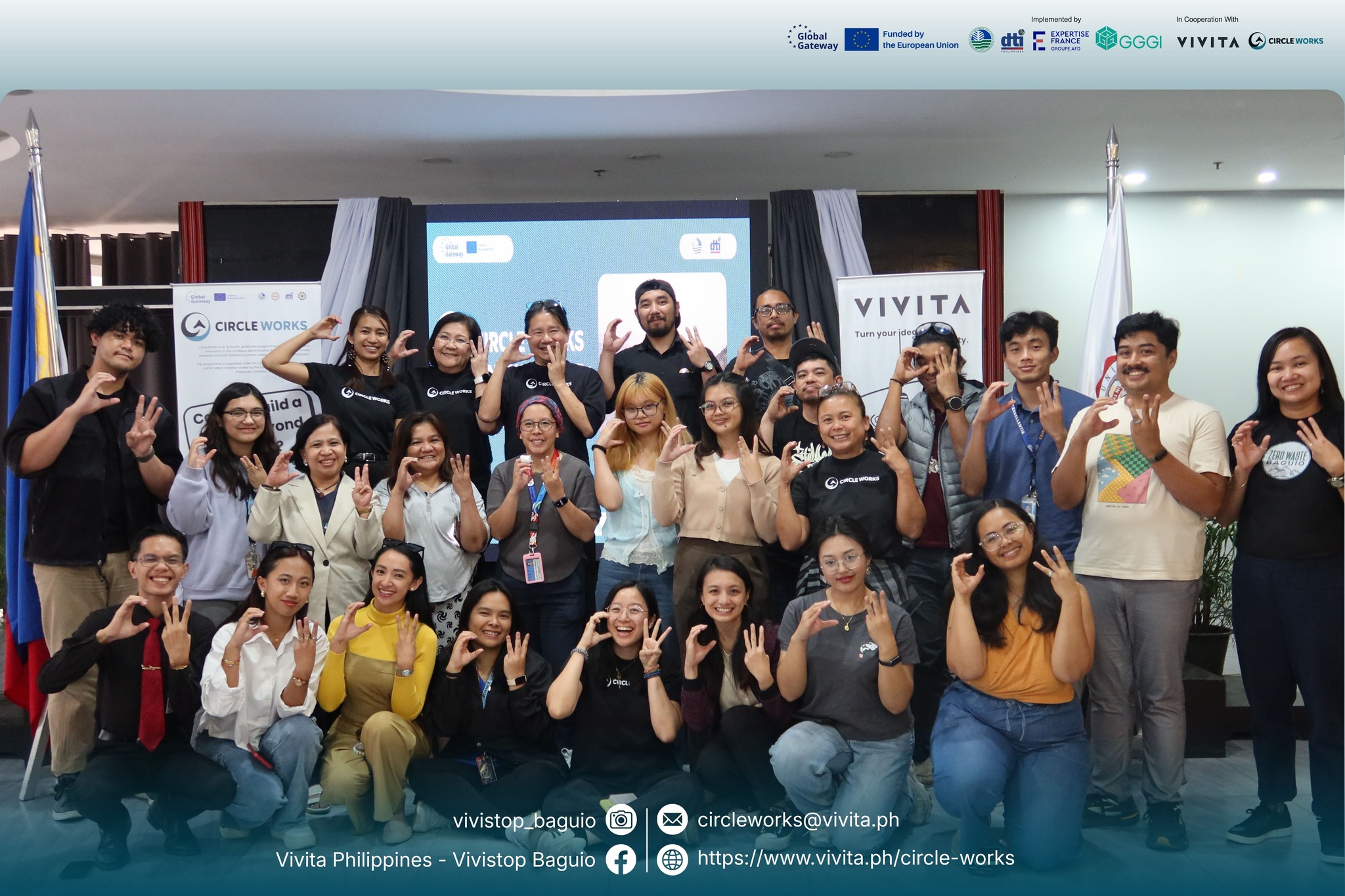
Circle Works, backed by the EU-PH Green Economy Partnership's €60 million fund, opened its Baguio leg on April 13, 2026, at the University of Baguio, offering students a structured pathway from circular economy concept to funded green venture.
 Featured Partner
Inv8 Studio
Innovation Partner for Startups & Growing Businesses
On April 13, 2026, the University of Baguio and Vivistop Baguio, Vivita Philippines signed a formal agreement and launched the Baguio leg of Circle Works, an 18-month youth circular economy incubation programme focused on plastic waste reduction and green startup development. The event, held at UB's Centennial Hall, brought together students from the School of Business Administration and Accountancy, the Baguio Business Club, the Rotary Club of Baguio Summer Capital, and university leadership for a community launch that included pitching sessions, a Repair Café, and a Circular Economy Learning Sprint.
The funding attached to this programme is real and specific. Student teams with eligible startup ideas can receive up to ₱600,000 in seed funding to implement their projects within the programme's structured timeline. For a student in Baguio with a working idea and no capital, that number changes what is possible.

What Circle Works Actually Is
Circle Works is a grassroots incubation programme built specifically for youth innovators in the Cordillera Administrative Region, targeting plastic waste as its primary problem and upstream circular economy solutions as its method. The programme runs in four phases: mobilization and foundation, community engagement through Repair Café events, formal incubation with design thinking and prototyping workshops, and a local demo day culminating in funded venture launches.
The incubation cycle focuses on what Vivita calls the "upstream" Rs: Refuse, Rethink, and Reduce. That framing is deliberate. Most waste programmes in the Philippines address downstream problems, collecting and processing what already exists. Circle Works asks participants to attack the problem before it becomes waste: redesigning products, rethinking consumption models, and building businesses that do not generate the problem in the first place.
The April 13 launch included five concrete programme elements. A Repair Café taught participants to fix broken items rather than discard them. Startup Incubation and Funding Pathway sessions introduced the route from idea to funded venture. The Circular Economy Learning Sprint showed how everyday products can be redesigned into circular business models. An MOA signing formalized the partnership between UB and Vivita Philippines. A Community Launch brought students together with the Baguio Business Club and Rotary Club of Baguio Summer Capital as active programme partners.
The Funding Behind It
Circle Works is supported under the EU-PH Green Economy Partnership, a €60 million (approximately ₱3.67 billion) grant from the European Union running from 2023 to 2028. The programme is co-led by DTI Philippines and the Global Green Growth Institute (GGGI) Philippines, overseen by DENR, and designed to accelerate the Philippines' transition to a circular, climate-smart economy through technology transfer, investment, and job creation. It directly supports seven Sustainable Development Goals: SDG 3, 11, 12, 13, 15, 16, and 17.
Baguio is not the only venue. Circle Works is designed as a CAR-wide programme, meaning the startup pipeline being built here is explicitly regional, not limited to the city. That scope matters for founders and students in Benguet, Ifugao, Mountain Province, Kalinga, Abra, and Apayao who are watching this launch from outside Baguio.
What This Means for Northern Luzon
A funded youth incubation programme with EU backing, an 18-month structured timeline, Baguio Business Club and Rotary Club participation, and a university MOA is a qualitatively different offer than a one-day workshop. It is the kind of programme that produces actual startups, not just participants. The Philippines generates approximately 2.7 million metric tons of plastic waste annually, with Baguio contributing to one of the highest per-capita waste loads among Philippine cities. Circle Works does not solve that on its own. But it builds the regional pipeline of founders who understand circular design at a systems level, and who have the funding to test whether their solutions work.
For students across Cordillera and Northern Luzon with startup ideas in plastic alternatives, repair economies, circular supply chains, or sustainable product design: the application window is open now. Students interested in applying or learning more can visit the official programme portal at vivita.ph/circle-works.
Original Source:
Market Context:
The EU-PH Green Economy Partnership runs from 2023 to 2028 with a €60 million grant from the European Union, co-led by DTI Philippines and GGGI Philippines under DENR oversight, targeting circular economy adoption, plastic waste reduction, energy efficiency, and green job creation. The Philippines generates approximately 2.7 million metric tons of plastic waste annually, with less than 10% properly recycled, making upstream circular economy interventions one of the highest-priority areas for government and development partner investment. Circle Works is among the first CAR-specific youth circular economy incubation programmes with formal EU-backed seed funding, operating within a national green economy transition framework that also supports green LGU infrastructure, sustainable finance, and private sector circular business models. The programme's ₱600,000 seed funding ceiling places it among the most accessible startup funding instruments currently available to student founders outside Metro Manila.
Are you a founder, innovator, or community builder in Northern Luzon?
We're always looking for compelling stories from the region's ecosystem. Whether you're launching a startup, running a program, or doing something interesting — we'd love to feature you.